
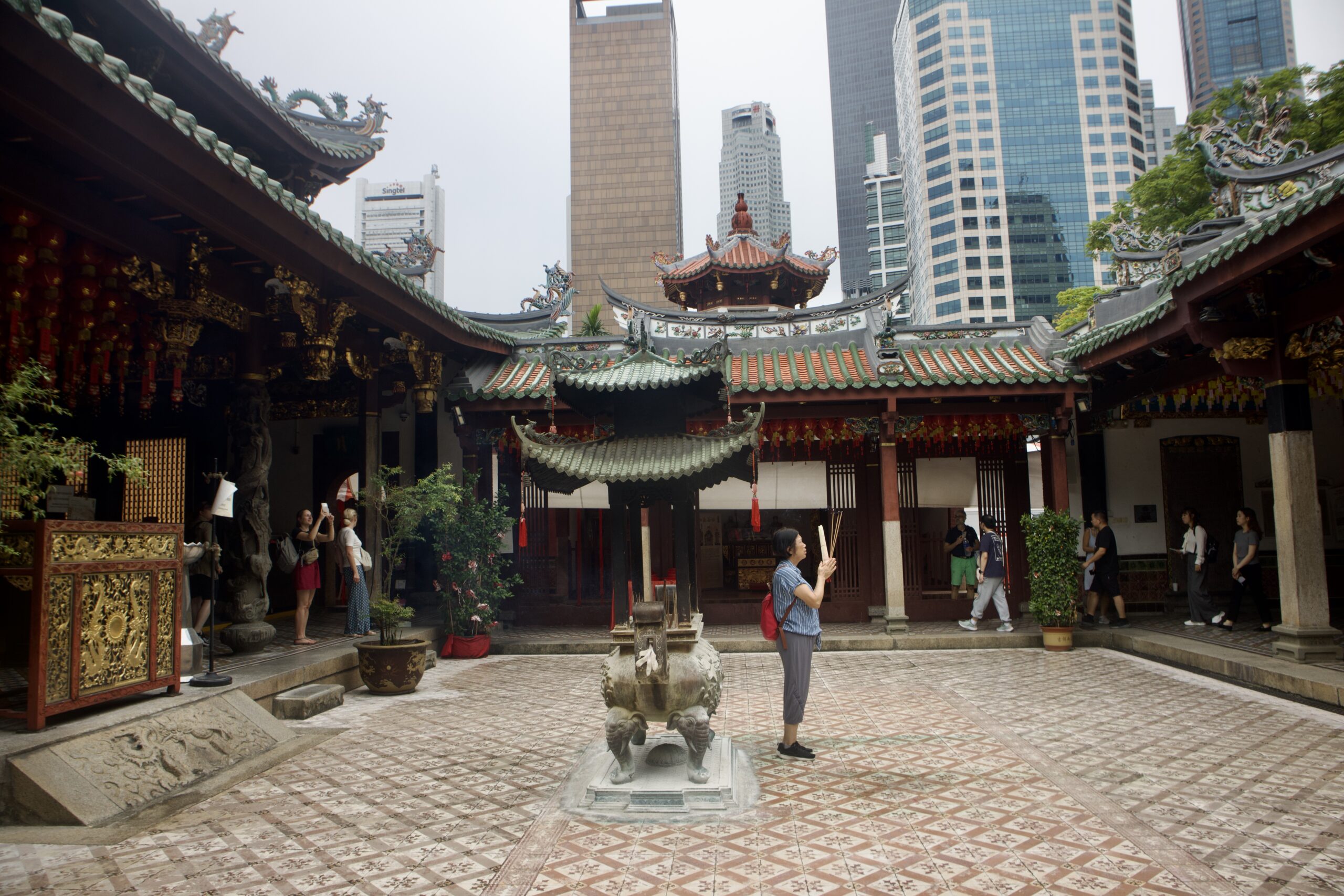
The inner courtyard of Thian Hock Keng Temple, a serene open space framed by sweeping Fujian-style roofs, offers a moment of stillness in the heart of Singapore. Skyscrapers rising behind it form a striking contrast to this historic sanctuary. Together, the ancient temple in the foreground and the modern skyline beyond capture one of Singapore’s defining qualities: its ability to preserve deep cultural roots while building one of the world’s most advanced cities.

The Lion City
A miracle of prosperity
A shining lighthouse of heritage
Pilgrimage of the modern age
Unity in diversity
The ideal made reality
Singapore is a living monument of a vision that grew from wisdom and belief in cultural strength and harmony as the foundation of a thriving society.
Across Asia and beyond, Singapore is viewed as a city of progress, a world-class financial hub and one of the rare economic miracles of the modern era. Yet a closer look reveals a city-state anchored in deep foundations, shaped to withstand and even harness extremes, reflecting the remarkable foresight of its founders. One essential feature of the Lion City stands out and captures a central truth about Singapore: its affluence did not arise from natural resources, of which it has none, but from human and cultural resources. It is a living demonstration of how moral and spiritual values can function as the invisible architecture of prosperity, forming the steady and enduring foundations of a modern nation.
People may share the same human nature everywhere, yet they are shaped by the ambience, culture, and identity of the place they live in. In Singapore, this shaping is evident in a distinct sense of order and in the harmonious coexistence of traditions, religions, and customs — the continual interplay between the ancient and the contemporary.
Singapore’s transformation under the leadership of Lee Kuan Yew emerged from the steady application of strategies grounded in realism, discipline, and long-term vision. Beneath these strategies lay a profound conviction: that modernization must not erode morality, and that true prosperity is built on cultural strength and human integrity.
There are other precedents of Singapore’s rapid and effective rise, most notably South Korea, Hong Kong, and Taiwan, the celebrated Four Asian Tigers. Yet no country has matched Singapore’s combination of economic achievement with the same depth of social cohesion, ethical governance, and alignment between self-interest and the collective good. In a world increasingly fractured by division, Singapore remains a rare model of what a nation can become.

A quiet morning scene in Singapore’s Bugis and Kampong Gelam district, where colorful shophouses line the street and the golden dome of Sultan Mosque rises gracefully at the center. The Bugis–Kampong Gelam area carries a warm, creative, and multicultural atmosphere. Traditional perfumeries, textile shops, cafés, and heritage boutiques sit side by side, reflecting generations of Malay, Arab, Indian, Chinese, and later international influences.
The foundations of today’s vibrant multicultural, multi-ethnic, and multi-religious harmony were laid long before the emergence of modern Singapore. For centuries, the region thrived along the great maritime trade routes of Southeast Asia, particularly during the era of the Malacca Sultanate, one of the most culturally diverse crossroads in the world, well before any European power set foot here. Ancient mariners and traders from China, India, and the Arab world converged in the waters around Singapore. Its geography placed it at the heart of major sea lanes, its natural harbour drew diverse communities, and over time these exchanges formed the cultural bedrock upon which today’s global city stands.
Islamic traders, Indian merchant guilds, and Chinese diasporic networks each left lasting marks on Singapore’s spiritual and cultural life, evident in its temples and mosques, its festivals, its languages, and its rich heritage cuisine. What emerged was a fusion of spiritual, cultural, and material flows that made Singapore the uniquely vibrant global city it is today.
Long before Singapore’s modern skyline rose, the island was known as Temasek, a bustling maritime settlement recorded in Chinese and Malay sources and, at times, linked to the Majapahit Empire, the powerful Javanese kingdom whose influence once reached across much of maritime Southeast Asia.
Malay legends tell of a Sumatran prince who, in the 13th century, glimpsed a mysterious beast upon its shores, an encounter that moved him to name the settlement Singapura, the Lion City, from the Sanskrit siṃha (lion) and pura (city). The name endured for its power, associated with authority, legitimacy, and divinely favored beginnings.

Sultan Mosque — Masjid Sultan — is one of Singapore’s most important Islamic landmarks. Built in the early 19th century for the Muslim community of Kampong Gelam, it remains a spiritual anchor for Malay and Indonesian families, as well as a vibrant cultural reference point for visitors. Its iconic gold dome and white minaret are instantly recognizable symbols of the district.

Riverside quietness in the middle of the city, where Elgin Bridge leads from Singapore’s trading past into the present. A historic crossing once approached by traders, merchants, and immigrants arriving by boat. The waterway that supported movement and exchange two centuries ago now flows toward the tall office towers of Singapore’s Central Business District, linking ancient trade routes to today’s global financial powerhouse.


Mature rain trees form a continuous green canopy above the road, filtering light, cooling the air, and creating a sense of calm amid the high-rise towers. In Singapore, lush landscapes are not cleared away but intentionally planned, designed, and integrated at every level: street corridors lined with native trees, vertical gardens and sky terraces on office buildings, green roofs, park connectors, and wetlands woven into the city’s infrastructure. What other cities treat as a challenge, Singapore transforms into a defining strength. Nature becomes an essential feature of the city, standing alongside the towers and shaping the cityscape as much as the architecture itself.


Singapore’s historic churches bear witness to the layers of European architectural influence introduced in the early nineteenth century. Many of these structures, from prominent cathedrals to parish churches, date to the era of Stamford Raffles, whose vision helped shape the foundations of modern Singapore. Under his direction, some of the island’s earliest churches, along with key civic buildings, were established as part of a broader plan for an ordered town, becoming defining features of the early urban landscape. Their preserved architecture, rich in Gothic Revival, Neo-Classical, and Victorian details, continues to tell the story of how Singapore evolved from a trading post into a multicultural city where history, faith, and modern development coexist in a uniquely harmonious way.

Spectacular Thian Hock Keng Temple in Singapore’s historic Telok Ayer district, surrounded by centuries-old craftsmanship that reflects the devotion of the early Hokkien community. Its ornate ridges, dragon motifs, and green-tiled roofs showcase the mastery of traditional Chinese artisanship brought by the island’s first immigrants. As the oldest Hokkien temple in Singapore and once a place where seafarers offered thanks for safe passage across the South China Sea, it is one of the city’s most significant cultural and spiritual landmarks.

A small, hidden street shrine in Singapore Chinatown offers a quiet corner where the Laughing Buddha, rows of deities, incense bowls, and small trays of offerings connect daily life with the divine. In Singapore, worship is naturally woven into the urban fabric. These humble, intimate spaces, often set against the walls of shophouses or tucked into alley corners, quietly affirm that even amid rapid modern development, spiritual life continues with sincerity, rooted in longstanding traditions that still guide the community today.
Unity in diversity is often used as an attractive slogan, but Singapore turned it into a lived experience. Its multicultural balance was not something inherited from history; it was intentionally and painstakingly built. The city may captivate the eye, yet its true distinction lies in the invisible framework beneath it — the values, decisions, and hard-won stability that anchor its success.
Behind this design stood a leader whose worldview was forged amid the pressures and uncertainties of a turbulent era. Lee Kuan Yew’s thinking emerged from the particular circumstances of mid-twentieth-century Southeast Asia, marked by the upheavals of war and foreign occupation, the strains of decolonization, the dangers of racial politics, and the daunting task of building a nation on a small island with no natural resources, burdened by deep social divisions and widespread poverty in the years following British withdrawal. These experiences sharpened his resilience and shaped a philosophy rooted in realism, foresight, and the conviction that Singapore’s survival required an enduring model of progress grounded in cultural integrity, social harmony, and collective discipline. His decisions were never driven by ideology, but by deliberate choices informed by hard experience and clear insight, always focused on securing cohesion and building a fulfilling future for the people he led, a rare union of disciplined pragmatism and far-reaching vision.
From these experiences emerged a personality both analytical and far-sighted, sharpened by a keen grasp of human nature and the realities of world affairs. It was this cast of mind that shaped Singapore’s course. He drew together the moral discipline of Confucian ethics, the administrative precision of British institutions, and the hard pragmatism imposed by circumstance. Out of this synthesis came a vision of a state whose prosperity would rest not on resources, but on character — on clean and incorruptible governance, a meritocratic public service, and a society prepared to take responsibility for its own advancement.

Masjid Malabar, Singapore’s striking mosque in shades of turquoise and gold, offers a vivid example of the architectural diversity found across the island’s mosques. Throughout Singapore, a wide range of styles can be seen, with no two mosques exactly alike. Some echo traditional kampong designs, others draw from Mughal, Arab, or Ottoman aesthetics, and many take on modern forms shaped by the city’s evolving urban environment. Together, these mosques form an essential part of Singapore’s multi-ethnic landscape and a source of continuity for Malay-Muslim families whose presence on the island stretches back centuries.

A beautifully preserved former residence of a wealthy Chinese trader in Singapore’s Little India. Its ornate wooden shutters and colorful plasterwork reflect the distinctive Peranakan and southern Chinese design traditions that once marked the homes of prosperous merchants. During the nineteenth and early twentieth centuries, Chinese traders, many of them Peranakans or southern Chinese immigrants who had risen to wealth through commerce, built richly decorated residences as expressions of status and success. The result is a uniquely vivid Singaporean architectural expression, where cultures meet, merge, and create something entirely new. Houses like this one form part of the cultural fabric of Little India and its surrounding districts, standing as reminders of the island’s cosmopolitan roots and the entrepreneurial spirit that helped transform the island into a global trading center.


Little India is home to some of Singapore’s most beautiful Indian temples, where vibrant colours, sculpted deities, and soaring gopurams create an atmosphere deeply rooted in South Indian tradition. Yet these temples are not confined to Little India alone. Even along Western-style streets or within modern high-rise districts, a towering gopuram may suddenly rise into view, asserting the presence of a living Indian heritage and devotional traditions woven into Singapore’s urban fabric. In the early morning and late afternoon hours, these temples come alive with prayers and processions, accompanied by an unfolding surge of ringing bells, priestly chants, and the powerful sounds of Indian drums and trumpets.

A view along the Singapore River reveals historic buildings lining one bank, with modern towers rising on the other. The neoclassical structure with its colonnaded façade houses the Asian Civilisations Museum, alongside the nearby Victoria Theatre and Concert Hall, both reminders of Singapore’s colonial-era architecture. In the distance stands one of the city’s most iconic landmarks, Marina Bay Sands, instantly recognizable for its three soaring towers crowned by a sweeping sky park, shaped like a ship suspended above the city. Its futuristic silhouette contrasts with the older riverside buildings, capturing Singapore’s urban identity, where historic institutions, cultural heritage, and cutting-edge architecture coexist with ease. This balance reflects a philosophy of urban planning in which progress is carefully integrated rather than imposed.

Jewel Changi Airport is a vast glass-and-steel sanctuary where nature and architecture merge into an immersive experience. Beneath its sweeping toroidal roof, sunlight filters through a lattice of geometric glass panels, illuminating the lush indoor rainforest that encircles the Rain Vortex, the world’s tallest indoor waterfall. Water cascades from the oculus above, creating a cool mist that drifts through dense greenery of palms, ferns, and tropical trees. Conceived as both a transit hub and a civic destination, Jewel embodies Singapore’s vision of a “City in a Garden.” Its atmosphere is serene yet dynamic, a place where travelers pause between flights, families gather, and visitors encounter the city’s commitment to integrating nature into modern life. Through its innovative architecture, restorative landscape, and extraordinary sense of scale, Jewel has become a contemporary symbol of Singapore, expressing ambition, creativity, and the belief that even the busiest spaces can be designed to feel alive, calming, and deeply connected to nature.
The legacy of Singapore, and of Lee Kuan Yew himself, offers profound and practical lessons about progress and prosperity, the parental role of leadership, high moral standards, and the pursuit of personal fulfilment without jeopardizing the interests of society. Singapore’s visible success rests on an invisible architecture of thought. Lee Kuan Yew began with high aspirations and a hard judgment of human nature, as well as a clear-eyed understanding of the vulnerabilities of a tiny, exposed city-state. He approached both the individual and society with stark realism about their weaknesses. That sober view, that human beings are capable of viciousness and must be guided away from it, led him to treat politics as the disciplined governance of human instincts, with order, trust, and predictability as the necessary preconditions for any chance at prosperity.
From there came a second pillar: the conviction that the strengths of each culture, race, religion, language, and nationality that make up Singapore’s mosaic constitute the nation’s deepest and most enduring capital. From his Confucian heritage he absorbed the virtues of duty, reverence for learning, and disciplined conduct, even as he rigorously rejected what he termed its “dark side,” the drift toward nepotism, favouritism, and corruption. Leadership, in his view, required moral example. Leaders had to “set the example in honesty and upright conduct,” so that even difficult or unpopular policies could never be dismissed as self-serving.
He believed that sound values take root early, in family upbringing, long before a citizen encounters the pressures of society. This conviction, that moral habits are shaped long before any policy is debated, underlies Singapore’s emphasis on education as central to nation-building and development. Education was designed both to unify a multicultural society and to equip citizens with the skills required for industrialization and trade, a dual imperative of social integration and economic viability. These policies helped forge a distinctive Singaporean identity, rooted in cultural respect and economic pragmatism, where education functions as both a moral foundation and a strategic engine of national advancement.
Singapore offers a way of seeing the world more clearly. At a time when many societies are torn by antagonisms, short tempers, and even shorter memory, this small city-state shows what can happen when citizens and leaders alike hold themselves to higher standards, keep their eyes on the long view, and refuse to let short-term quarrels or division sabotage their future.
What makes Singapore especially striking is the way two contrasting but complementary forces continue to grow side by side. On one side, there is a constantly evolving sphere of progress: advanced infrastructure, global finance, research, and technology, all tuned to the demands of a changing world. On the other, there is a deep-rooted landscape of traditional heritage and religious faiths — temples, mosques, churches, clan associations, family rituals, and everyday practices that carry memory and meaning across generations. Instead of cancelling each other out, these two spheres gradually converge around a shared aim: cultivating virtuous human life and a harmonious social environment. Modern systems provide security, opportunity, and order; inherited traditions offer moral orientation, restraint, and a sense of belonging. Together, they form the foundations of a civilization that measures prosperity not only in income or skyline, but in the quality of character it nurtures and the peace it manages to maintain in a restless world.
A nation is not built on words, but on deeds, on the daily conduct of its people.
— Lee Kuan Yew
Being a Singaporean is not a matter of ancestry. It is a conviction and a choice.
— S. Rajaratnam
Leave a Reply