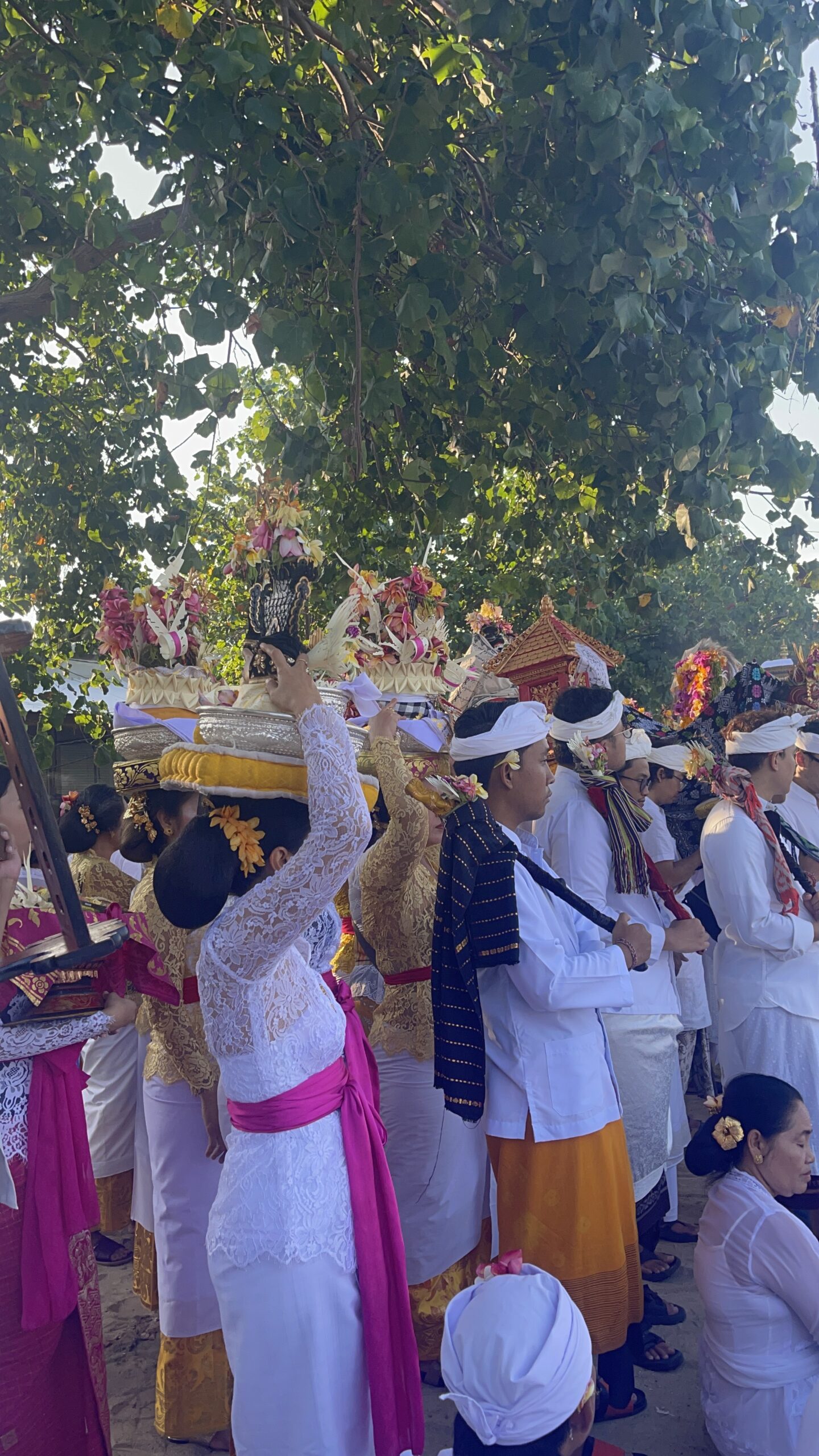
Women in beautiful white and gold ceremonial kebayas with bright selendangs, balancing figures of deities on their heads. A grand display of the magic of Balinese culture during a Tilem purification ritual.
Like other forms of art in Bali, Balinese fashion has roots deeply anchored in rituals, ceremonies, and temple life, reflecting the island’s renowned and unparalleled aesthetic. A wide array of ceremonial fabrics, complemented by delicate gold and silver jewelry, bracelets, rings, and necklaces, and glittering accessories for prayers and offerings, showcases a sophisticated attention to detail designed to honor the gods’ discerning taste.
Balinese fashion creates a captivating world to experience and explore, a truly remarkable source of beauty and inspiration.
Balinese kamben-style attire captivates with its exquisite fabrics and timeless designs. Artfully draped as kamben, these garments reveal intricate patterns, gracefully enveloping the body from the waist down to the feet. A harmonious fusion of beauty, tradition, and cultural sophistication.
Dressing in traditional Balinese style is a remarkable experience that involves wrapping, folding, and tying various fabrics to create elegant, accentuating details. Each layer, from the intricate kamben draped around the lower body to the vibrant selendang sash tied at the waist, and the spontaneous folds of the udeng headdress for men, showcases the art of maneuvering untailored yet striking pieces of cloth into a cohesive and dignified ensemble.
Ensuring every detail fits perfectly and remains secure throughout the day, especially during long ceremonies, is a true creative craft. This unique process of dressing becomes a transformative ritual, lifting the wearer into a more elevated state of being, perfectly attuned to the sacred atmosphere of temple prayers and ceremonial gatherings.

Temple procession with Balinese women in gold kamben carrying offerings under ceremonial umbrellas, with a Barong entourage behind.
An Endless Playlist of Culture and Rituals

Barong Landung couple Jero Gede and Jero Loeh are taken in procession in Sanur, with colorful textiles and poleng featured across their garments.

Temple courtyard alive with offerings and guardian deities dressed in cloth, while pemangku priests arrange ceremonial displays under yellow canopies.

Dramatic black-stone temple gate with guardian figures wrapped in poleng and red ceremonial cloths.

Elderly devotees seated near temple shrines during a ceremony, draped in beautiful kambens.
Bali offers an unceasing stream of temple festivities, rituals, and ceremonies. With hundreds of temples celebrating odalans, their twice-annual anniversaries, and countless other events, the island pulses daily with artistic and spiritual vitality.
These festivities revolve around elaborate offerings, constant prayers, and the steady flow of devotees arriving to honor the divine. They highlight Bali’s unmatched dedication to pleasing the gods, displaying the extraordinary aesthetic of Balinese culture, where ceremonial life profoundly shapes fashion.
This influence extends beyond clothing, permeating everyday and temple life with aesthetic charm. Conversely, fashion in Bali also shapes culture and ceremonial practices. Balinese fashion is omnipresent, in the visual nature of worship-based traditions, the intricate décor of temples, and the elaborate offerings to the gods.
It is especially evident in the extensive use of sacred textiles, which symbolize purity and divinity. During temple festivals, shrines, guardian statues, temple gates, and surrounding holy trees are adorned with sacred fabrics, creating an enriched, energized atmosphere in which everything appears exquisitely clothed.
As an integral part of these ceremonies, adorning the human figure in beautiful fabrics becomes an essential act of devotion, transforming the rituals into extraordinary displays of beauty, reverence, and style.
The Magnificience of Kamben

Balinese woman in a dark songket kamben with a traditional cloth headdress at a royal cremation in Sanur.

Family portrait in colorful kebaya and kamben attire, seated before gilded palace doors during a festive ceremony in Celuk.

Balinese woman in a yellow kamben and red selendang preparing offerings beneath a sacred banyan tree.

Woman in gold and white kamben entering the Denpasar palace courtyard, beside a guardian figure carved in stone.
The kamben, a stunning wraparound fabric, forms the foundation of traditional Balinese attire. Draped from the waist down, it is complemented by a decorative sash and the udeng, the traditional headdress for men.
For women, the kamben is wrapped from left to right. For men, it is wrapped to the left. Over the kamben, men add a second layer called the saput, often in a contrasting color to enhance its visual appeal. Women, too, wear a variation of the saput, tailored to their attire.
Women’s attire is particularly mesmerizing, with vibrant fabrics and dazzling accessories, often culminating in processions where women gracefully carry elaborate offerings on their heads. A sight that encapsulates the Island of the Gods’ spiritual allure.
During special ceremonies, women might don a shimmering gold kamben as the first layer, topped with a shorter white garment that lets the gold cascade to the feet, exuding an air of imposing dignity.
Both the kamben and the layered saput are essential for temple visits and ceremonial participation, symbolizing purity and reverence for the temple deities.

Kebaya designer Desak Ayu in a self-made pink lace kebaya, placing a garden frangipani behind her ear.
Balinese fashion has evolved, incorporating elements like the kebaya, a delicate lace blouse with Javanese roots, into the traditional ensemble of women’s attire. At times, it replaces elaborate geringsing, songket, and other older Balinese garments that once wrapped the torso and upper body.
These traditional pieces, along with a smaller piece of endek cloth worn across the shoulders, are still seen during special ceremonies and marriages, and regularly in Bali Aga villages that maintain more archaic Balinese traditions.

Children’s dance troupe wearing marigold flower headdresses and gold sashes, waiting to perform the sacred Balinese Rejang dance.

A bride wearing gilded ceremonial headdress with embroidered textiles and shoulder patterns.

Styled udeng paired with a richly patterned kamben and gold jewelry, worn during a palace marriage ceremony.

Bride and groom in songket attire outside a richly carved royal palace hall.

Row of colorful rangrang and cepuk cloths unique to Nusa Penida, hanging on a wooden rack in front of Goa Giri Putri temple.
Traditional woven cloths stand as bold statements of the unique extravagance of Balinese heritage. Among these, fabrics such as endek, songket, and geringsing are celebrated for their craftsmanship and symbolic motifs.
Together with many lesser-known or forgotten textiles, they stand apart from contemporary fabric. Endek is known for its vibrant ikat patterns, created by tie-dyeing threads before weaving. Songket, often adorned with shimmering gold or silver threads, is traditionally reserved for ceremonial or royal occasions.
The most extraordinary of all is the double-ikat kamben geringsing, crafted exclusively in the ancient Bali Aga village of Tenganan in Karangasem. Unlike mass-produced textiles with ever-emerging patterns, these classic Balinese fabrics remain masterpieces of weaving, each piece endowed with a unique, magical language in its patterns and colors.
The Lavish Selendangs

Lace kebaya with layered geringsing sash (selendang) and a deep red fan, as a festival procession passes palace gates decorated with offerings and incredible Balinese ceremonial umbrellas.

Temple offerings prepared during a ceremony; kebaya and beautiful selendang worn with dignity and poise.

Devotees at the Dalem Ped temple gate, Nusa Penida, with guardian statues wrapped in poleng cloth.
The third piece of cloth, tied around the waist, is an eye-catching sash known as the selendang, or the slightly smaller umpal, worn as a belt. Exquisitely decorative and secured to the saput, it is an essential part of entering holy places and of offerings and prayers.
Women often wear long, vibrant selendangs, a defining element of feminine style in Bali, especially during major ceremonies when they take part in processions, parading in seemingly endless lines while carrying figures of gods and offerings.
The perfectly coordinated colors of their attire, combined with the upright poise of their bodies and the fluid rhythm of their movements, create a sight more powerful than words can convey.
Udeng: The Epitome of Style and Manliness

Simple yet stunningly dignified attire of a Sanur Brahmin: a white shirt, black udeng with a vivid red hibiscus, and layered kamben and saput.

A Javanese traditional blazer fused with an udeng and Balinese kamben.
In Balinese menswear, the udeng, a traditional head cloth, stands out as the ultimate styling element, crowning the silhouette with elegance and purpose.
Beyond its aesthetic appeal, the udeng serves a profound function, protecting the head and aura from external influences. In Balinese spirituality, wearing an udeng symbolizes enhanced self-control, a cornerstone of living a spiritually disciplined life.
It is more than an accessory. It is a statement of style, strength, and manliness.

A noble family from the Pemecutan palace in black ceremonial dress, with checkered saput poleng worn by the children, carrying the palace’s symbolic whip (pecut) during a royal cremation procession.
Mastering the art of tying an udeng by hand requires time and practice, but the effort is well worth it. A skillfully wrapped udeng not only enhances the Balinese outfit but also adds a youthful, refined touch.
Among the many traditional udeng styles, each hand-wrapped creation carries its own look, reflecting the wearer’s individuality and attention to detail. Modern preferences for convenience have led to the popularity of tailored and ready-made udengs. While these pre-tied versions accommodate busy lifestyles, they lack the artistry and spontaneity of the traditional method. For those who continue to embrace the timeless tradition of hand-wrapping, the udeng remains a defining feature of Balinese menswear, a personal signature of enduring style and depth.
The Sacred Power of Balinese Textiles

Procession toward the Sanur shoreline with umbrellas, flags, and offering paraphernalia; sacred textiles animate the scene.

Night temple ritual with cloth-shrouded Rangda performers marked with protective symbols, praying before the performance.

Devotee carefully wrapping sacred masks in inscribed ritual cloths after a temple performance.
Balinese textiles are more than beautiful fabrics. They are artifacts infused with sacred power and an indispensable medium in ceremonial life. Many types of cloth, including lesser-known varieties, are used to protect ceremonial items such as sacred masks, which are always wrapped in these fabrics to preserve their divine vibrations and sanctity.
In the dynamic duels between Barong and Rangda, textiles adorned with symbolic markings and inscribed with spells play an integral role, channeling divine energy and amplifying the potency of the ritual.
Saput Poleng: Black-and-White Balance

Shrine statue and sacred banyan tree roots wrapped in black-and-white poleng cloth beside an offering table.

Giant deity figures Jero Gede and Jero Loeh styled in black-and-white poleng cloths and ceremonial textiles.

Community temple dignitary wearing a white kamben with a poleng sash, descending temple steps beneath towering red-brick gates.
It is impossible to discuss Balinese fashion without mentioning the iconic black-and-white checkered cloth, saput poleng, celebrated for its profound symbolic and sacred significance.
The term saput translates to “blanket,” while poleng means “two-toned,” reflecting its alternating color pattern. This distinctive textile is deeply rooted in Balinese culture, embodying the concept of rwa bhineda, the coexistence and balance of opposites such as light and dark, good and evil, pleasure and pain which lies at the heart of Balinese philosophy.

Temple guardian statue dressed in black-and-white poleng, with a hibiscus offering placed above.

Pecalangs, guardians of order during ceremonies, wearing poleng sarongs as part of their uniform.

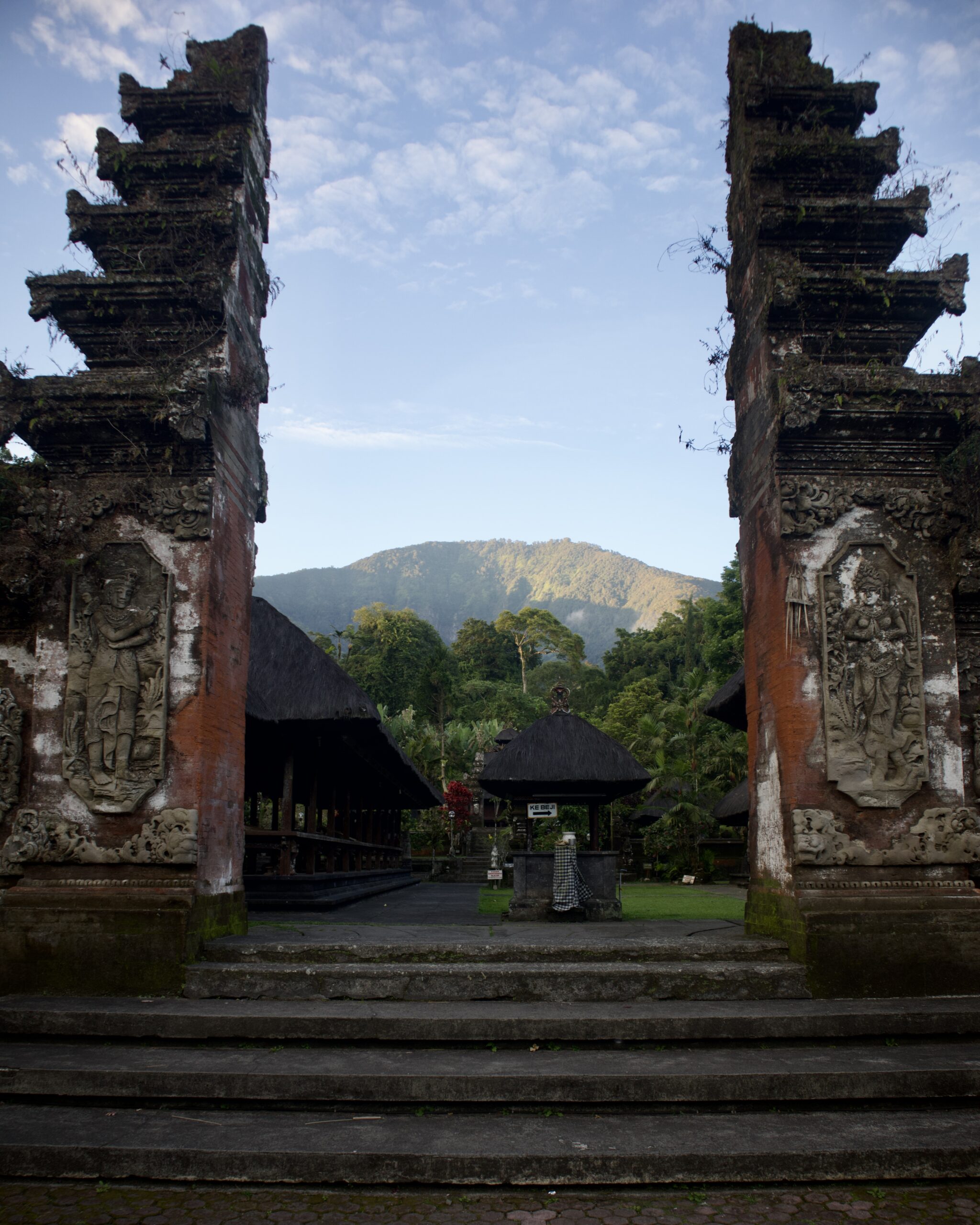
The sacred water temple on the slopes of Mount Batur, seen from the inner courtyard, with a tree wrapped in red and white poleng guarding the sacred space.
In Balinese society, the saput poleng is present in both sacred and everyday contexts. It is commonly wrapped around statues, sacred trees, and temple structures, signifying the sanctity of the object. Traditional security personnel known as pecalangs wear the saput poleng as a waist cloth over their kamben, serving as a uniform during ceremonies and festivals. This attire distinguishes them in their role as guardians of balance and order within the community.
Beyond its symbolic significance, the poleng cloth has also influenced Balinese fashion, inspiring contemporary designs that blend traditional motifs with modern aesthetics.
Textiles as Offerings: Wastra Banten

Spectacular sight of women carrying golden offerings of sacred textiles, continuing their procession through heavy rain.

Shrine with presented offerings and wastra banten textiles, arranged as part of sacred offerings placed before the deities.

Elaborate banten and textile offerings carried by women, surrounded by colorful umbrellas and temple ornaments.
During temple festivals such as odalan, it is common to see graceful Balinese women carrying elaborate offerings adorned with carefully arranged and folded kambens and other traditional textiles.
These unique cloth offerings, known as wastra banten, with wastra derived from the Sanskrit word for “garment”, are an integral part of banten suci, the sacred offerings placed at temple altars to seek divine protection.
The Splendor of Theatrical Costumes

Night procession featuring masked performers, with richly layered ritual textiles catch the light.

Topeng mask costume with an ornate collar and a pink-gold songket panel.

Temple courtyard in Candidasa alive with colorful kambens, as women perform ceremonial dance moving in harmony while carrying offerings.
Bali’s extraordinary cultural heritage is inherently theatrical, with temple ceremonies often becoming captivating stages of performance.
From the evocative storytelling of Topeng mask characters to the powerful rhythms of gamelan orchestras, traditional dances, and spontaneous bursts of devotional trance, this is a vibrant world steeped in drama, heightened by elaborate costumes and powerful masks.
A Legacy of Style and Spirituality

Interior designer Dewi Kencanawati in a tailored cream-yellow kebaya, standing by the window of her wooden joglo in Sanur.

Mannequin styled with an udeng, Javanese blazer, poleng sash, and red overlay.

Everyday elegance: Dewi’s casual yet uniquely styled pink kebaya and kamben in her lush tropical garden.
Balinese fashion captivates with its blend of ornate traditional elegance, vibrant temple-attire fabrics, and timeless style. It also serves as a source of inspiration for casual chic and everyday wear.
Though modern fashion has become less elaborate, striking examples of artful, diverse styles continue to creatively uphold cultural traditions.

Pemangku priest adorning guardian statues in the innermost temple courtyard of Pura Desa, in the heart of Denpasar.
Balinese traditional life is grand and abundant, where tradition and creativity intertwine effortlessly. Its diverse attire, along with contemporary interpretations, reflects the unparalleled elegance and distinct style of Balinese fashion, honoring the enduring heritage of the Island of the Gods.
Leave a Reply