Deep beyond the material
An untamed ocean ethereal
In the present time
A wondrous tale medieval
One of the most enchanting features of Bali, and a vital component of Balinese daily life that even short-term visitors inevitably encounter, is the Balinese temple, a true cornerstone of the island’s culture and its fairytale-like ambiance. Often referred to as the “Island of a Thousand Temples,” a number that represents only a tiny fraction of the actual count, Bali is home to countless temples, each offering insights into the island’s more nuanced dimensions. Balinese temples present a window into the depth of Bali’s extraordinary temple culture and timeless traditions, embodying the eternal struggle between good and evil, where the divine and eternal meet the mortal and transitory to recharge, rejuvenate, reinvent, and regain momentum.
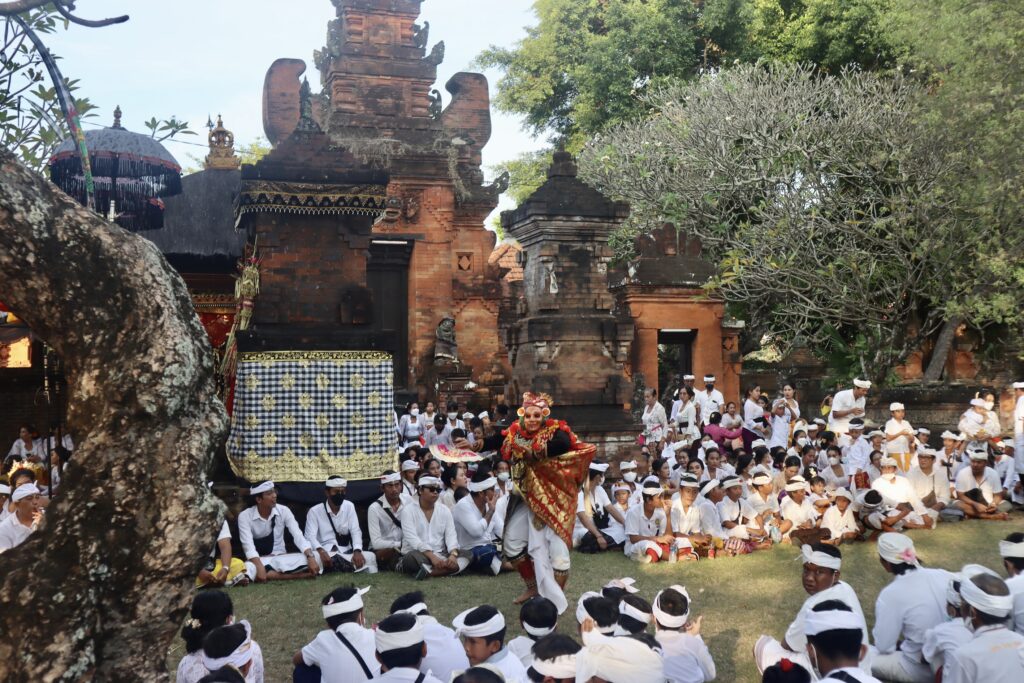
A Topeng mask performer holds the courtyard in unwavering attention during Tilem Kajeng ceremonies at Pura Dalem Kedewatan in Sanur.
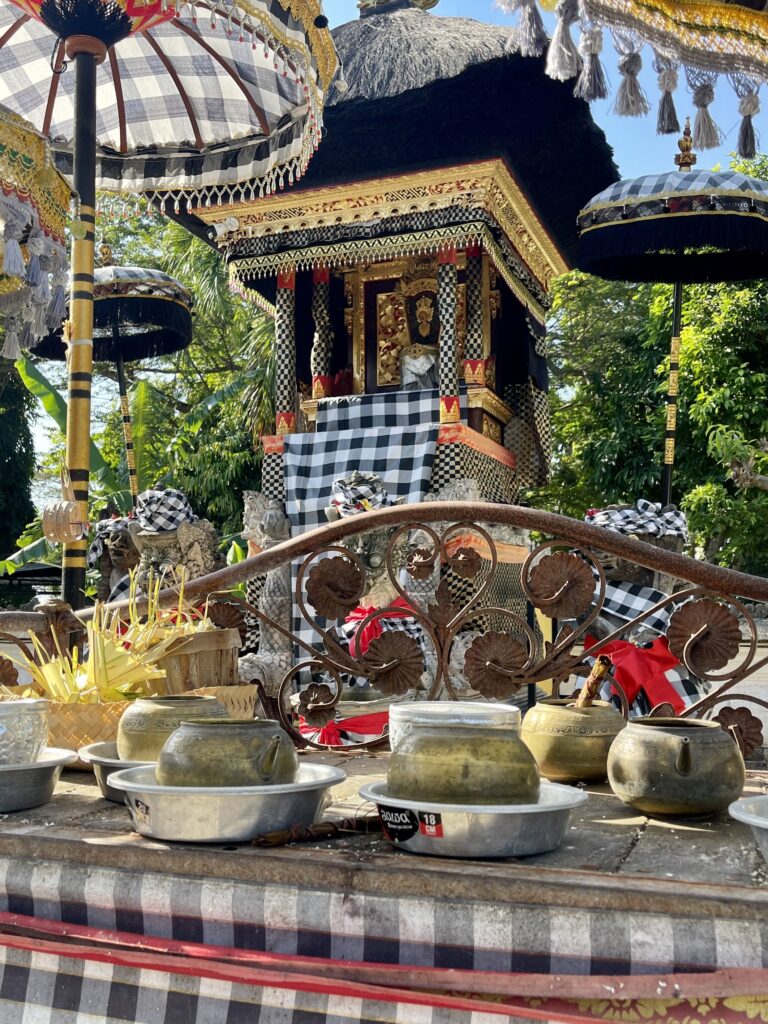
Below: Holy water vessels at the Ratu Niang shrine, Dalem Ped Temple (Nusa Penida).
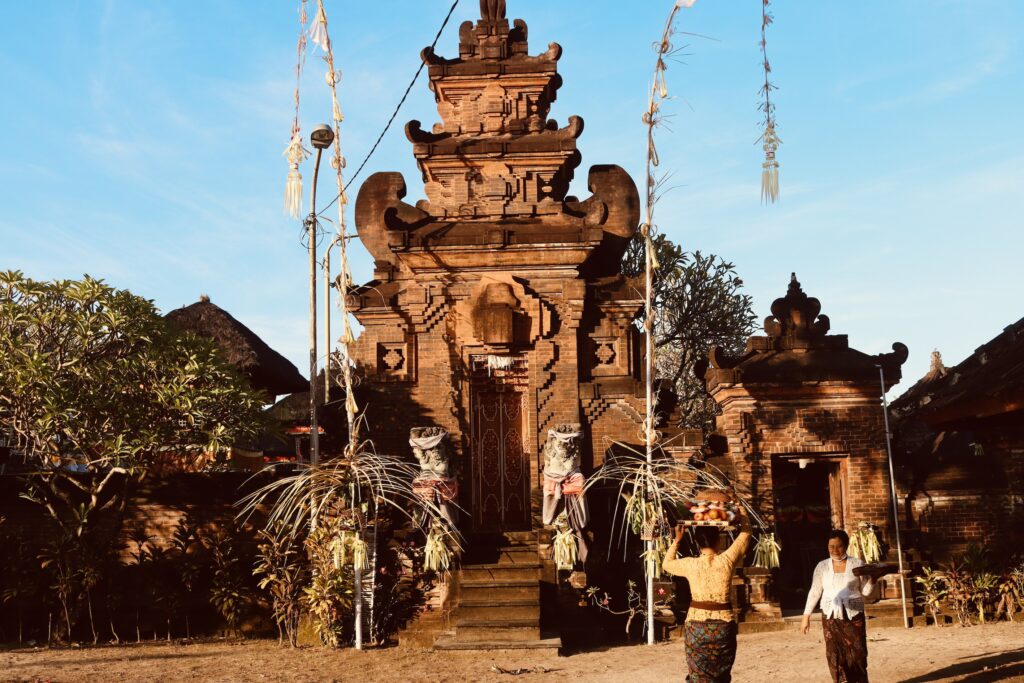
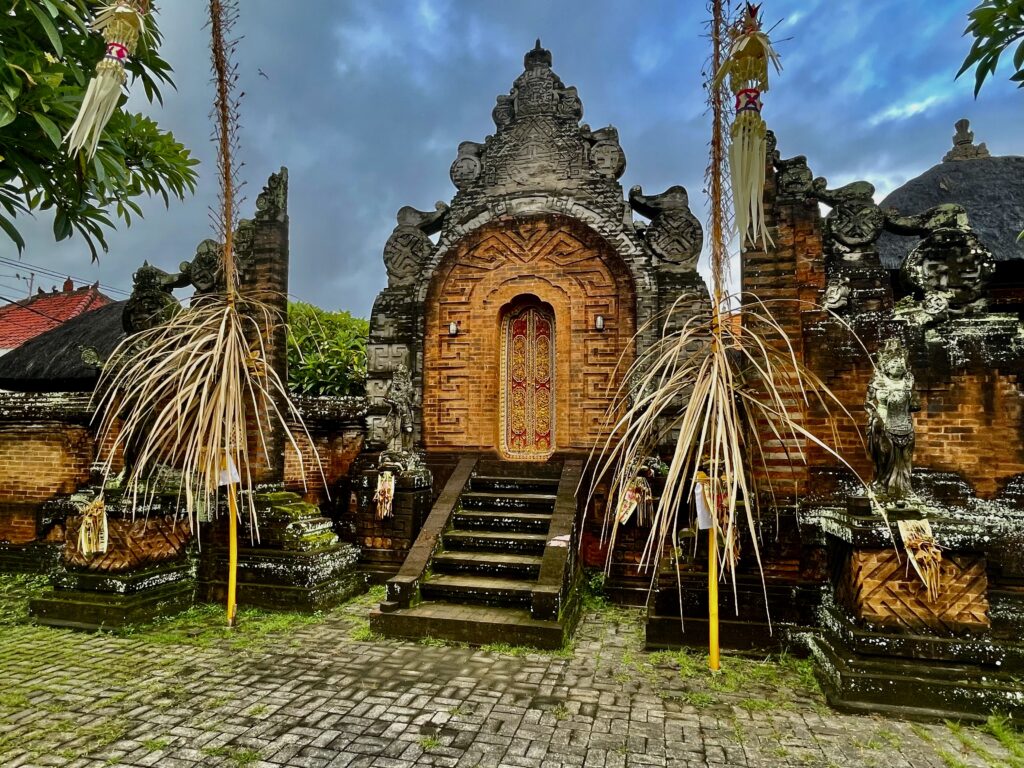
Beautiful ornate temple gates in the Intaran area of Sanur.
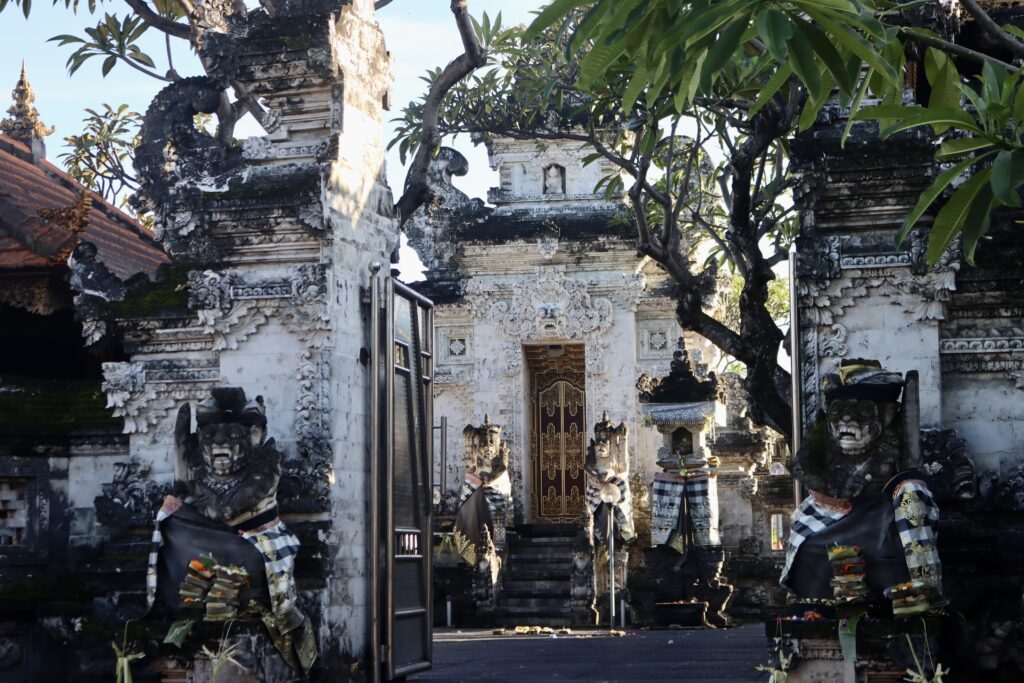
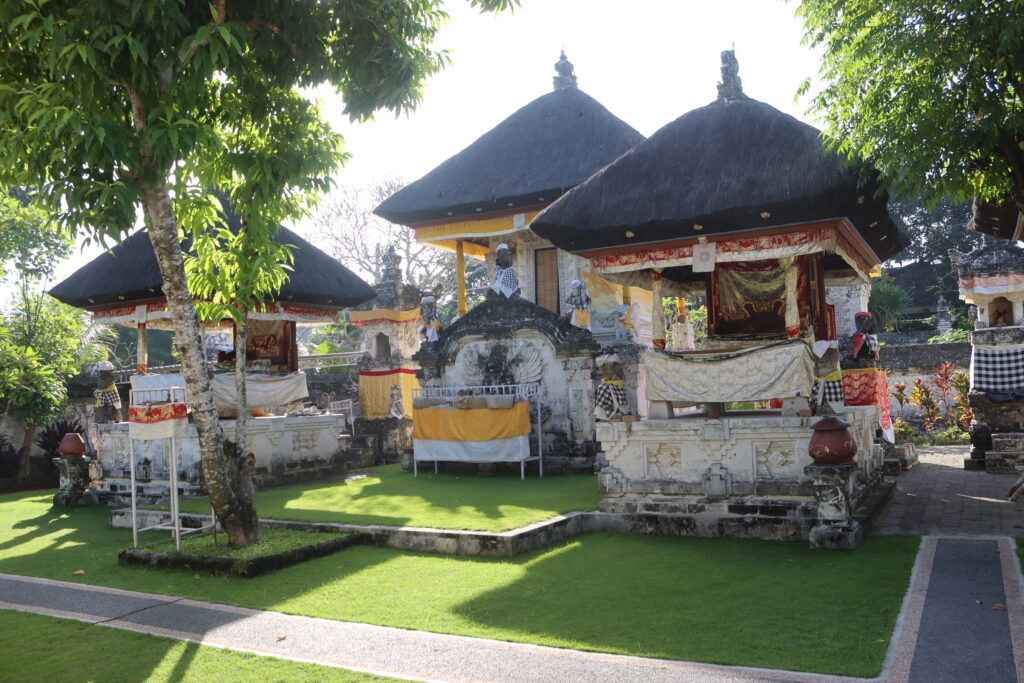
A serene temple jeroan, where open pavilions, carved stone shrines, and neatly arranged greenery reflect the inner sanctuary.

Sacred mask of Sanur’s Pura Dalem Kedewatan. Devotees with particular affinities wear specific masks that embody unseen forces within the temple grounds.
The Balinese way of life is profoundly ritualistic, characterized by elaborate practices of worship, daily offerings, and meticulous preparation and distribution of these offerings both within and outside homes and temple compounds. Daily offerings and prayers at home shrines, family and public temples, street junctions, and many dedicated locations for laying offerings throughout community permeate Balinese life and every aspect of its spiritual tradition. Propitious days according to the Balinese calendar, such as full moon, new moon, and the special Kajeng Kliwon day, which occurs twice each month, as well as larger ceremonies held mostly twice a year, are marked by elaborate offerings, joint temple prayers, and various expressions of devotion and sacrifice to the divine in its many forms, encompassing gods and goddesses, ancestral lineages, animate and inanimate objects, and natural forces that shape and affect everyday life.
During ceremonies, temple grounds are transformed into theatrical stages where visual and mystical dramas unfold, with exquisitely adorned deities departing for and returning from processions and being cared for according to strict protocols, masked actors displaying enviable storytelling talent, and overall anticipation and tension heightened by sudden bursts of ecstatic trances among devotees touched by the divine presence.
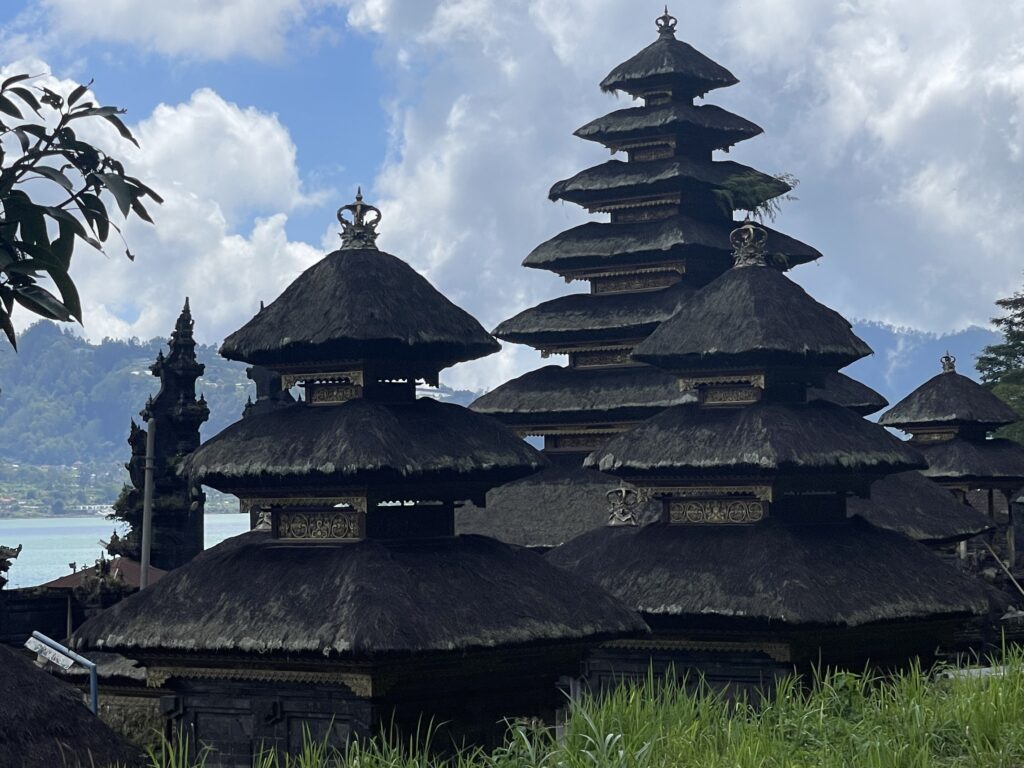
Beautiful thatched tiers of Pura Ratu Shakti rising above the waters of Lake Batur and the mountain landscape of Trunyan.
Balinese temples are the sacred abodes of the gods. They are both spiritual sanctuaries and aesthetic marvels, uplifting the mind and soul of any devout seeker. Even the most uninitiated visitor is often left speechless, overwhelmed by the temple’s wonders, its profound silence, and the aura of unfathomable mysteries. Balinese temples resonate with the living presence of gods, goddesses, and spirits, reflecting the depth, identity, and vibrancy of Balinese culture. They are extraordinary places of mass divine connection.
Often nestled within lush landscapes, Balinese temples harmoniously blend into their verdant surroundings, appearing as architectural masterpieces that embody a heritage of sophisticated aesthetic norms and refined taste. When delving into their intricate shapes, particularly those of the ancient temples, one encounters symbols and designs expressed through towering meru shrines, split gates, guardian statues wrapped in patterned cloth, Garuda carvings, and stone reliefs portraying mythological scenes, celestial beings, and age-old narratives, revealing and concealing the spirituality and deep mental frameworks of Balinese culture.
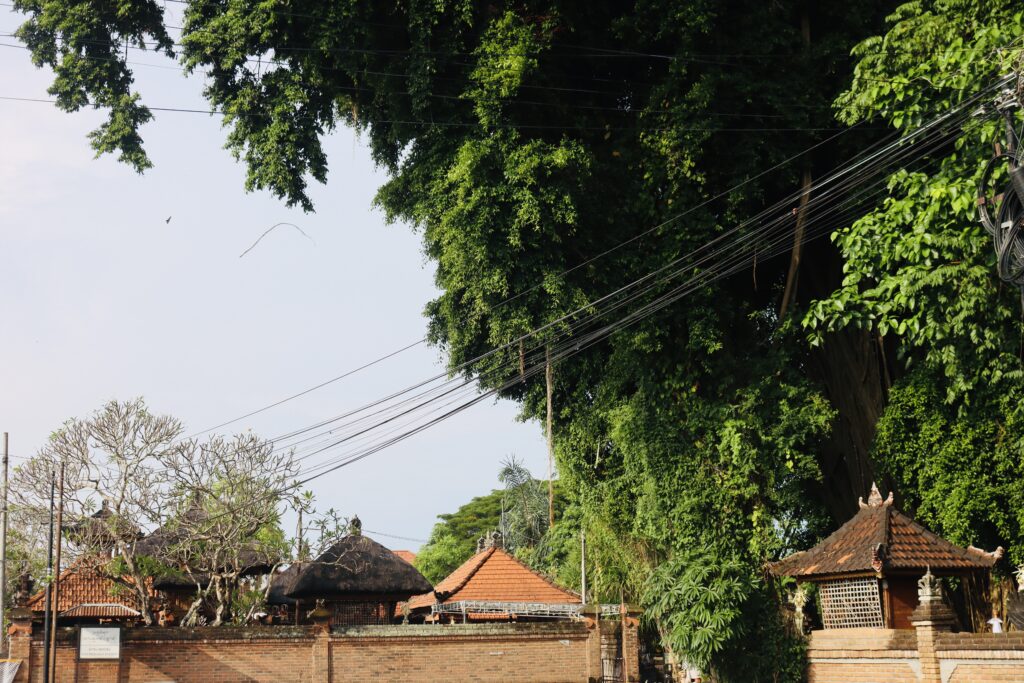
Weathered brick temple walls beneath towering banyan trees in Sanur.
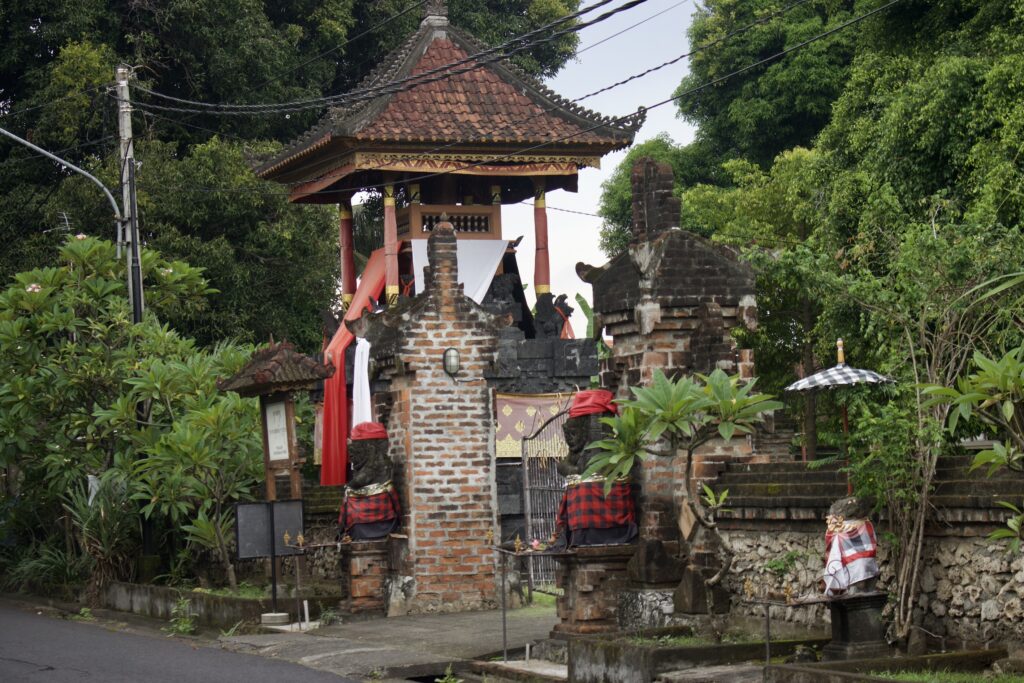
Entrance to Pura Agung in Sanur, where a brick gateway, guardian statues in checkered cloths, and lush greenery mark the threshold into the temple’s inner world.
Historically dominated by red brick and terracotta, a direct inheritance from ancient Majapahit, regarded as Bali’s cultural and religious predecessor, Balinese temples developed distinct architectural styles, building materials, and decorative details across different regions of the island. Over the past decade, a sweeping trend toward rebuilding temples in black lava stone has markedly transformed their aesthetic character, with many temples increasingly taking on a more imposing black appearance. Despite these changes, many older terracotta temples endure, and safeguarding these architectural remnants remains essential for preserving Bali’s layered cultural heritage.
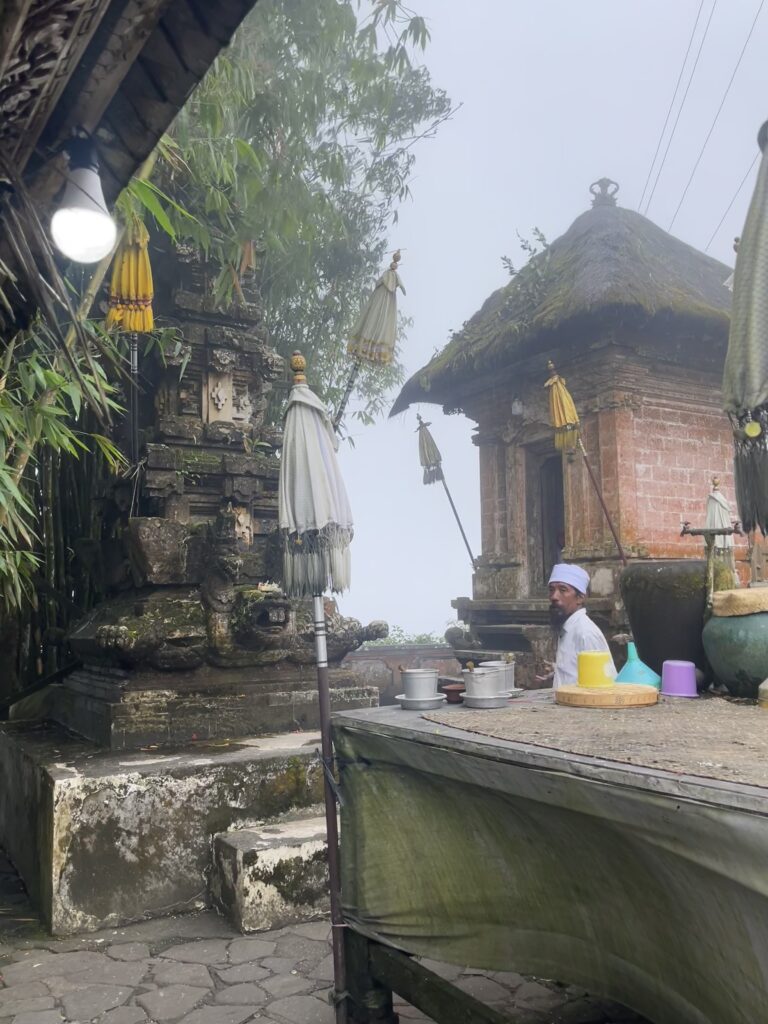
High in the hills, the innermost sanctum shrine of Pura Lempuyang Luhur, approached through mist, forest, and an ascent of 1,700 steps.
However, fathoming the essence of Balinese temples, the lighthouses of Bali’s ancient civilization, is perhaps more a matter of direct experience than theory. The Balinese are practitioners rather than preachers, living their spirituality through daily rituals, offerings, and ceremonies, and demonstrating a profound connection to their faith. This continuous practice provides a more straightforward path to the empowering fountain that lies beneath, where the quiet blessings of Betara-Betari (gods and goddesses) elevate the mind and offer a refreshing uplift to the soul and life as a whole.
Observing the daily ritual carried out in almost every Balinese household—the preparation and distribution of ‘canang sari’, a colorful square offering dish (10×10 centimeters) made from sacred flowers and plants, alongside a smaller triangular dish ‘segehan’ handwoven from banana leaf strips, containing white and yellow cooked rice and colorful petals—provides insight into the uniqueness of the Balinese way of life. This ritual highlights their unceasing interaction with the world of invisible beings, seeking support and protection through constant remembrance and offerings.
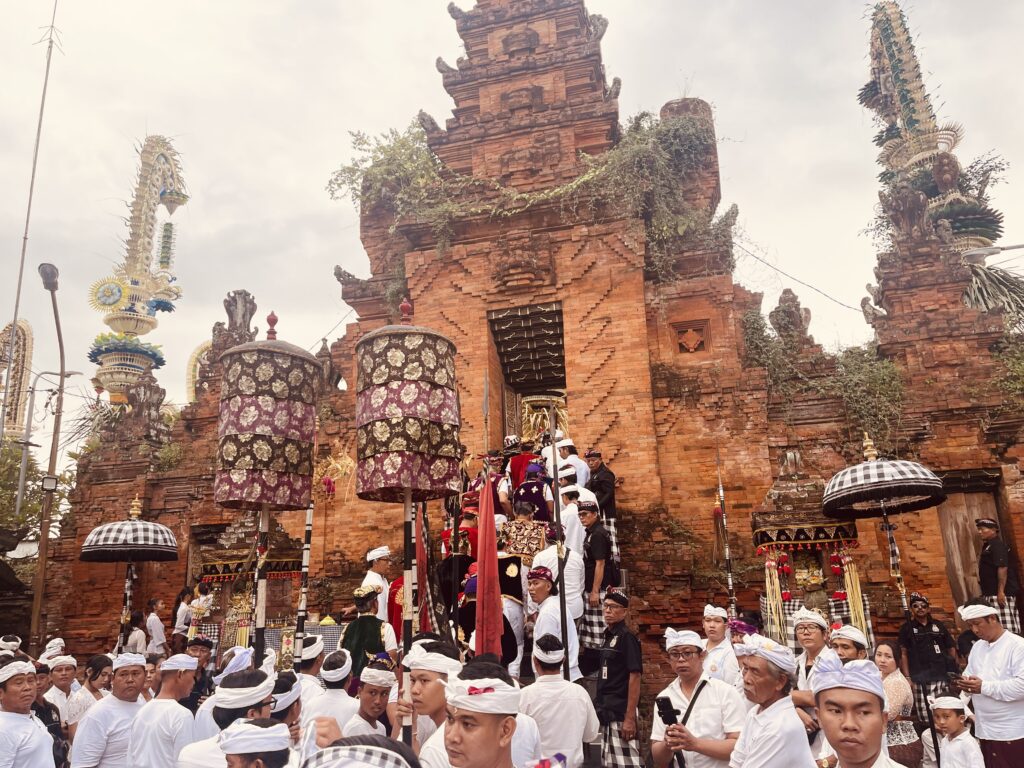
Trance mediums ascending through the old gate of Pura Agung Petilan during the Pengerebongan ritual in Kesiman, wearing ancient ceremonial costumes reserved solely for this rite, as the temple space becomes charged with unseen forces.
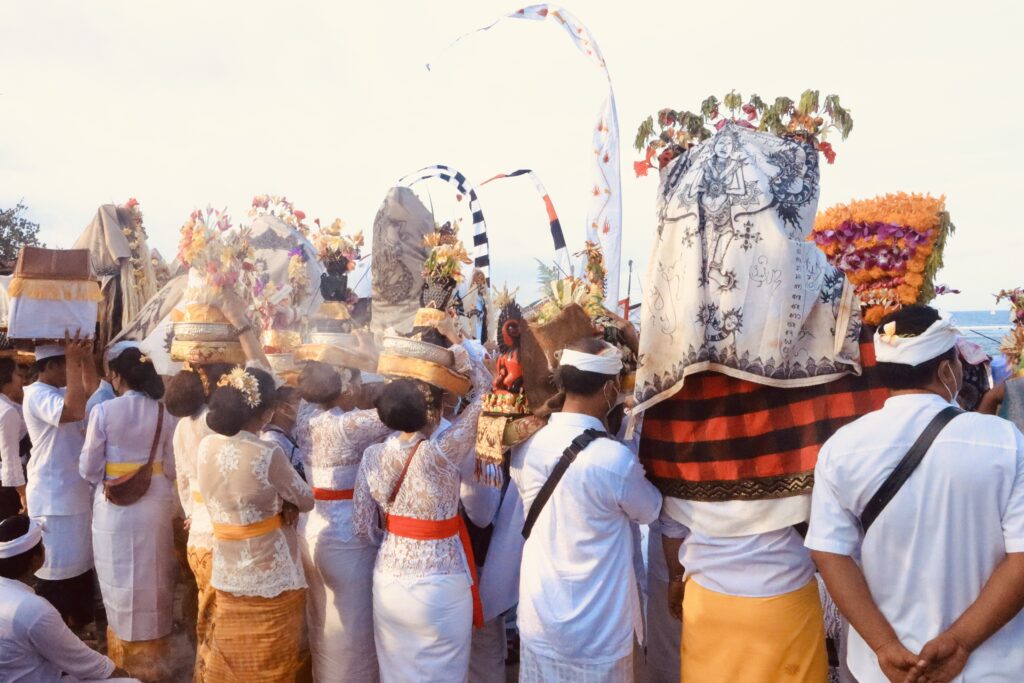
Procession along the Sanur shoreline, with ceremonial umbrellas, flags, and offering paraphernalia accompanying the presence of Balinese deities.
Temple ceremonies are a perpetual feature in Bali, taking place across the island at all times in its countless temples. The modest daily offerings of canang sari expand manifold during the biannual temple odalan anniversaries and other grand ceremonies. These events feature magnificent processions, where men and women, dressed in beautiful ceremonial outfits, accompany temple deities beneath striking traditional Balinese umbrellas, along with a myriad of offerings. Such occasions create unrivaled visual spectacles, all set to the sounds of the gamelan, the traditional Balinese percussion instruments. The unpredictability and spontaneity of each ceremony, despite being passed down through generations, makes every event feel refreshingly new.
Every medium to large temple in Bali is a living example of the island’s rich tradition of courtyard design, an integral element of its ancient architectural system. Most temples typically feature at least two or three courtyards. The outer courtyard, known as jaba, serves as a space for temple festivals, dance performances, and other communal activities. The middle courtyard, jaba tengah, acts as a transitional space from the outer to the inner sanctums, often containing shrines dedicated to land spirits where prayers are offered to greet the “hosts” of the temple.
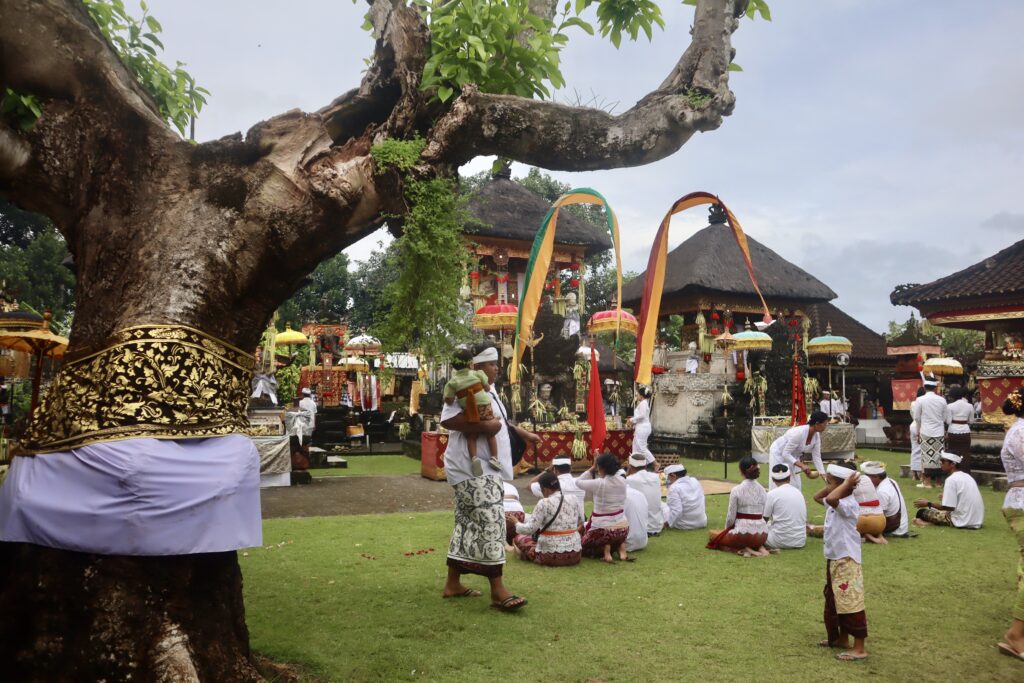
Festive atmosphere during the temple anniversary (Odalan), with Balinese arriving for prayers in the innermost courtyard of Pura Agung in Sanur.
From here, one enters the innermost heart of the temple, the JEROAN, through a richly carved and imposing wooden entrance gate of striking narrowness. The steep stairs leading upward, together with the gate’s tall and slender form, evoke mythical visions of a celestial pathway to heaven, a spectacular sight that seems to give physical form to the idea of a stairway to heaven.
In the innermost courtyard, a great deal of activity unfolds throughout monthly, biannual, and annual festive seasons. During these periods, constant prayers, offerings, and trance rituals take place, with a steady flow of beautifully attired worshippers arriving until late. Despite the bustling activity, the inner courtyard retains an atmosphere of peace and sanctity enveloped in the rich fragrances of offerings and aromatic incense, creating a deeply serene and heavenly ambiance.
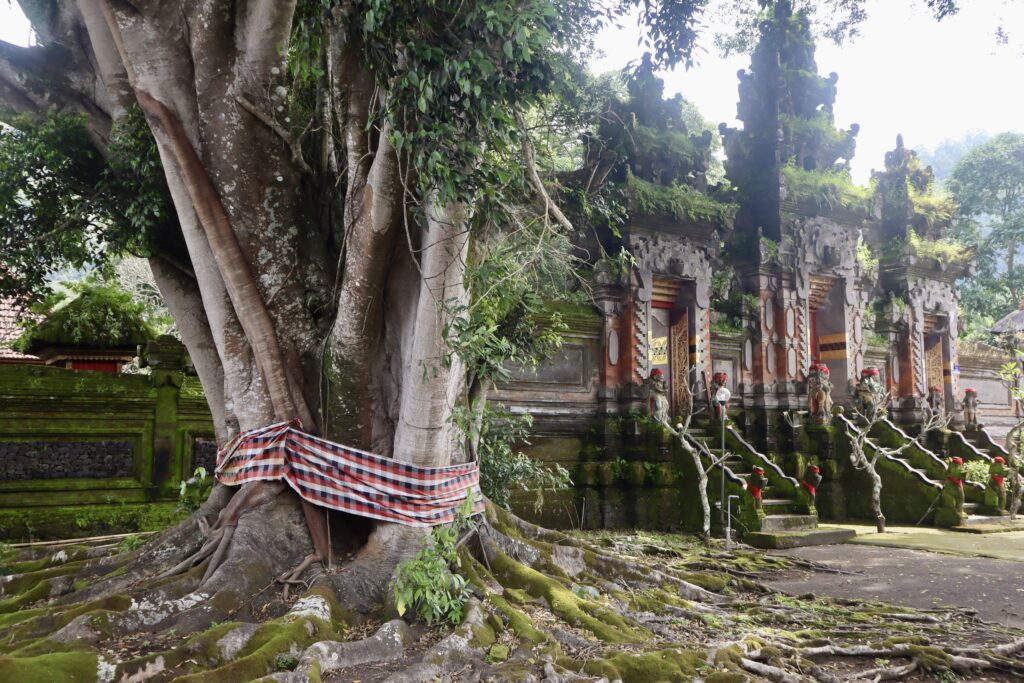
The sacred water temple on the slopes of Mount Batur, seen from the inner courtyard, with a tree wrapped in red and white poleng guarding the sacred space.
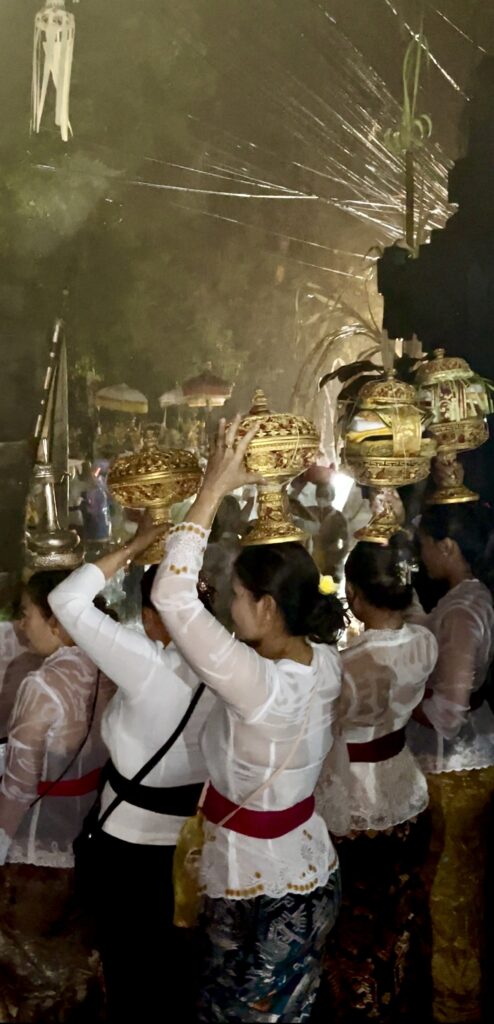
It is difficult to determine which aspect of Bali’s rich temple activities offers the most captivating experience, whether visual or auditory. Is it the vivid imagery of temple decorations, the many shrines and deity symbols adorned with fragrant offerings, or the natural grace of the Balinese arriving for prayer in traditional garments? Perhaps it is the finely crafted performances, where sacred dances unfold to the resonant, metallic sounds of gamelan instruments, Bali’s grand orchestra of gongs. Or perhaps it is the spontaneous theatrical plays featuring Topeng masks, rich in humor and parody, dramatic turns, and fierce duels, bringing to life otherworldly characters through hours of storytelling. Or it may be the long and intricate processions of deities, their golden effigies carefully balanced on the heads of men and women as they make their way toward the nearest beach for ritual purification, a powerful display of Balinese devotion to the divine.
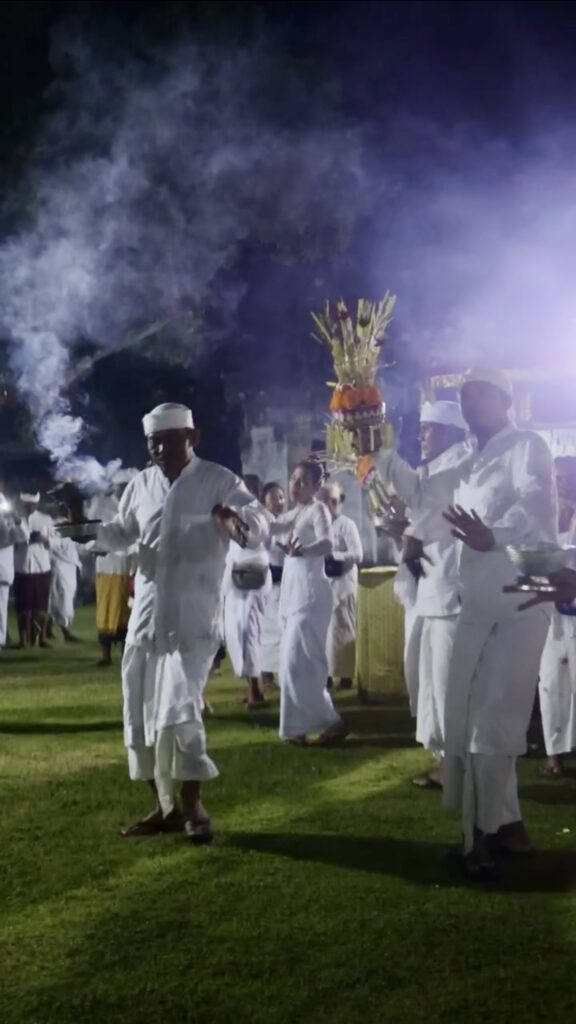
In Bali, one often encounters pemangku priests, male and female, who serve as caretakers of Balinese temples. Dressed entirely in traditional white attire (with men wearing distinctively fashioned pemangku headdresses), they lead collective temple prayers, chant sacred hymns, and possess a deep understanding of the intricate complexity of Balinese offerings, known as banten. They oversee temple life, ensure the proper flow of rituals, and awaken devotees from trance by sprinkling holy water. Pemangkus diligently perform daily temple activities across the island and stand among the most dedicated guardians of Bali’s temples and spiritual heritage.

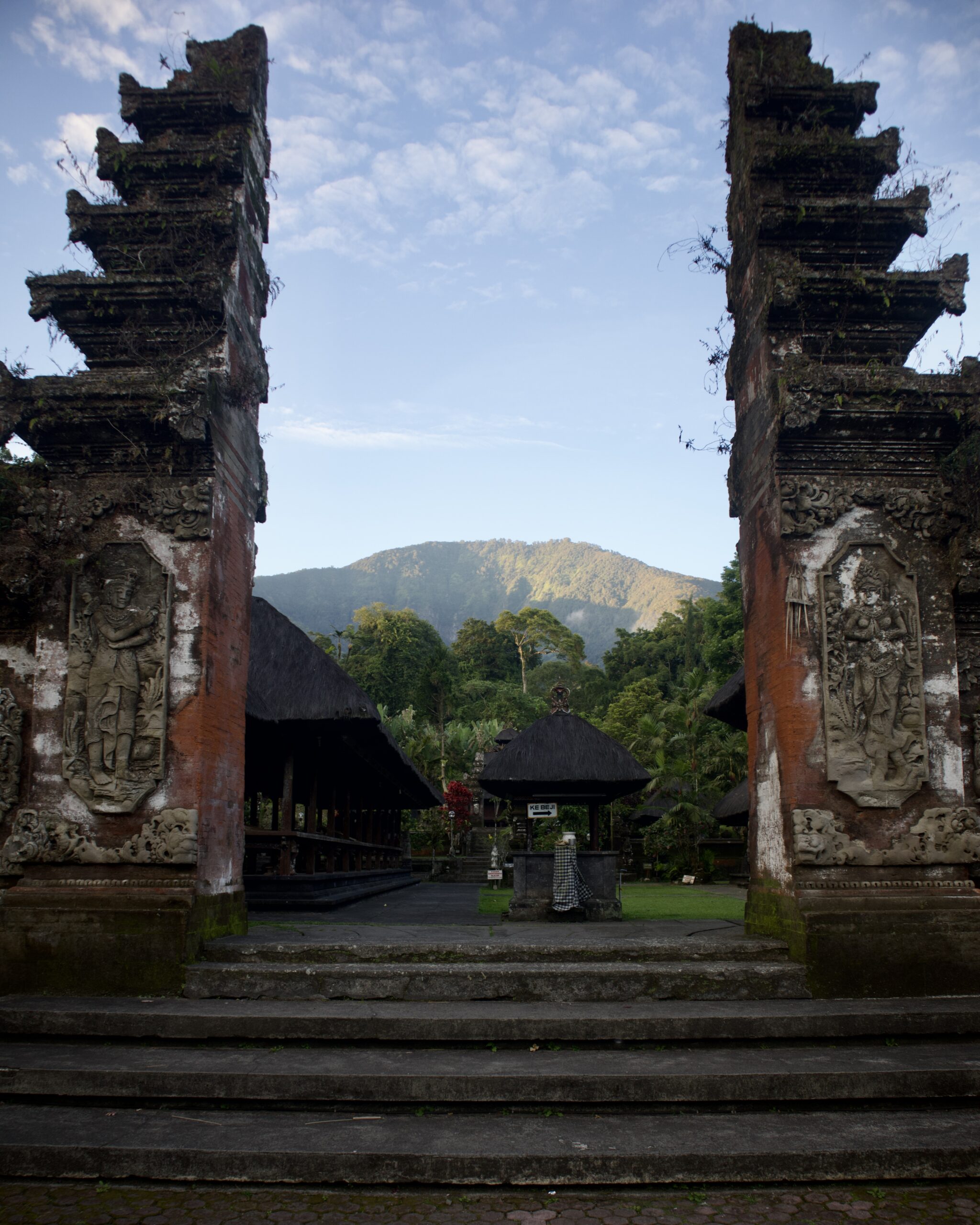
Spectacular red-washed, moss-covered candi bentar (split gate) of Pura Luhur Batukaru, opening toward Mount Batukaru and the inner courtyards.
Approaching Pura Luhur Batukaru, nestled at the foothills of Mount Batukaru in Tabanan, feels like entering a hidden, fantastical world, reminiscent of the fairytale realms of Tolkien’s Hobbits or the deep forests of Brothers Grimm tales. Leaving behind the last mountain village on the route to the temple, visitors embark on a breathtaking, kilometer-long journey through a lush tropical forest. This sanctuary, teeming with towering trees, diverse ferns, orchids, and mosses, buzzes with the vibrant sounds of birds and wildlife, acting as a natural barrier. It’s a zone of magical stillness, effectively separating the mundane from the mystical aura that envelops the temple.
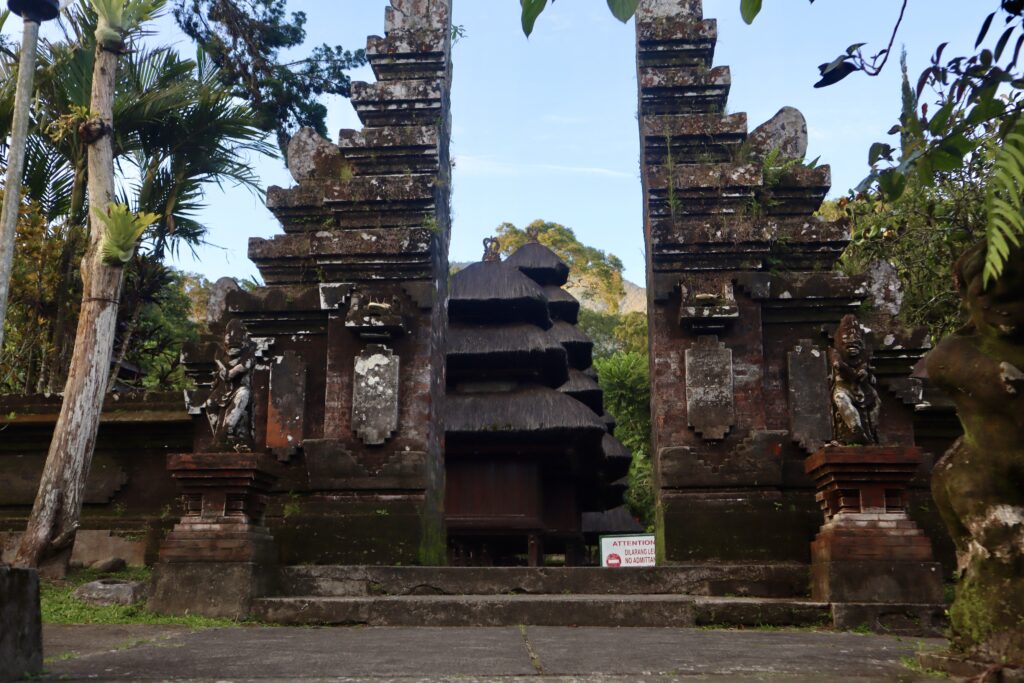
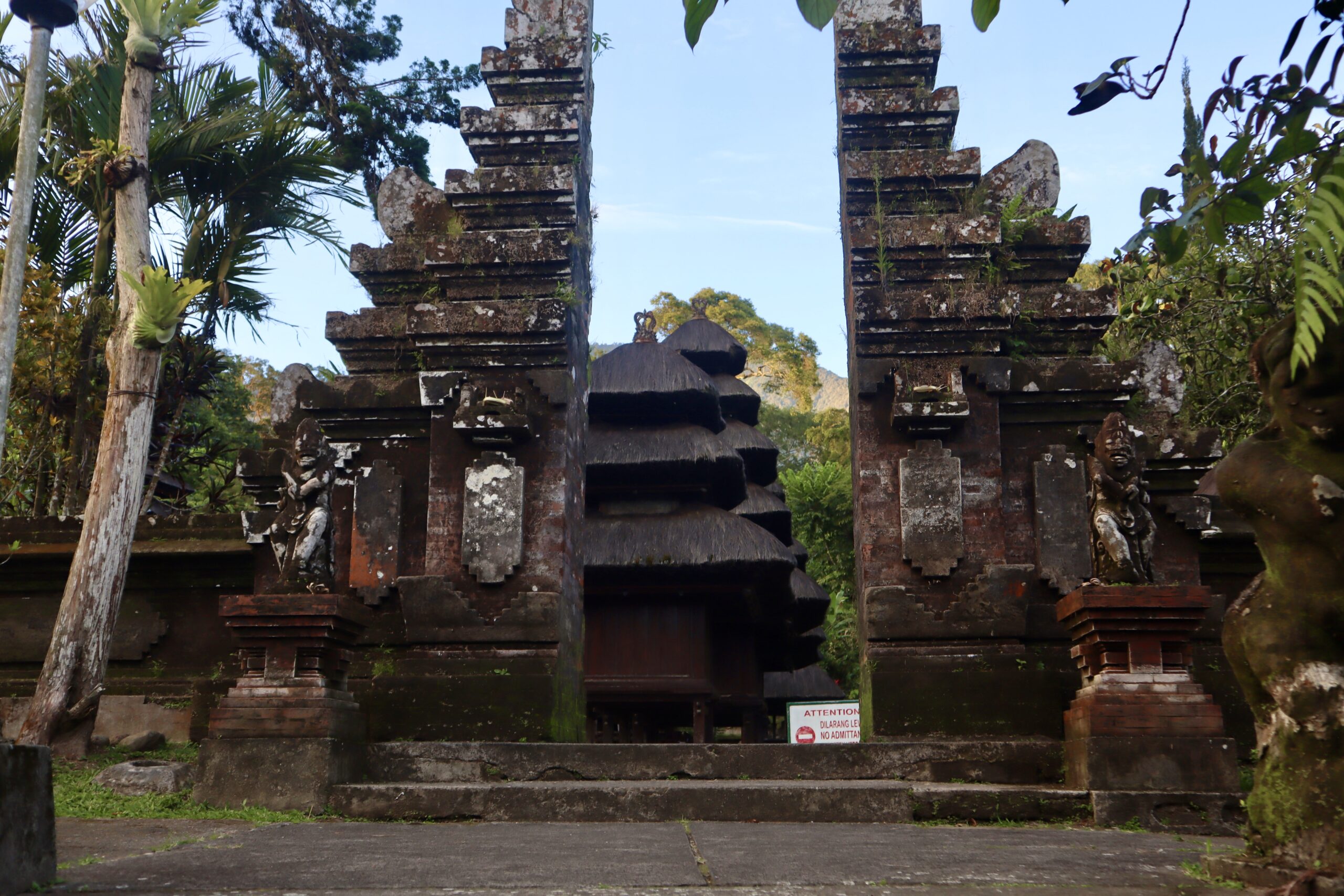
An ancient gate marking the passage into Batukaru’s inner sanctum.
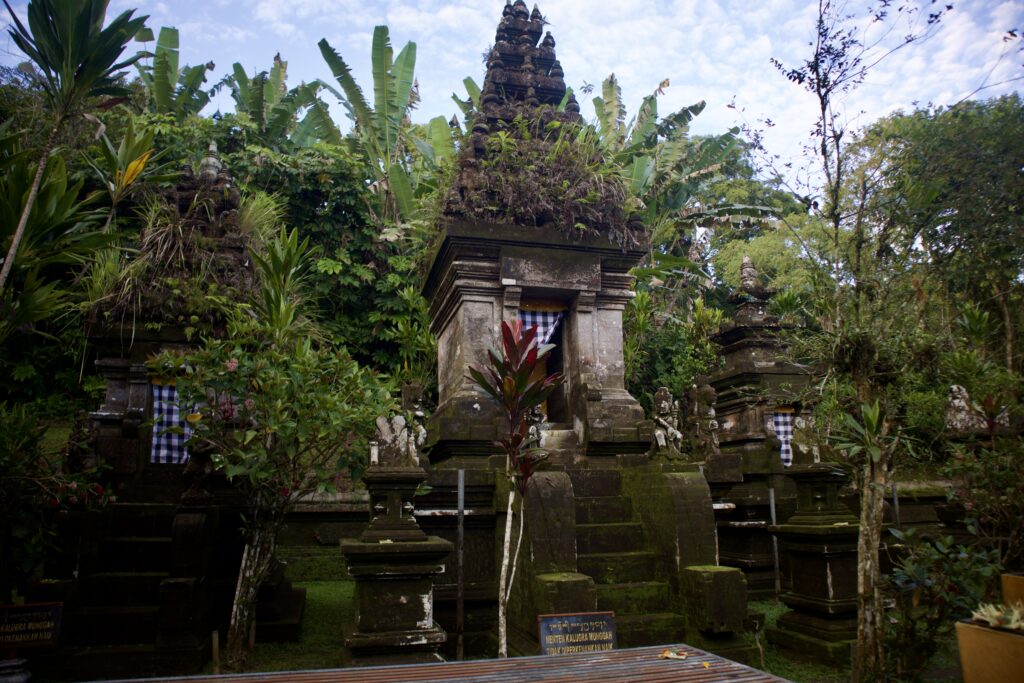
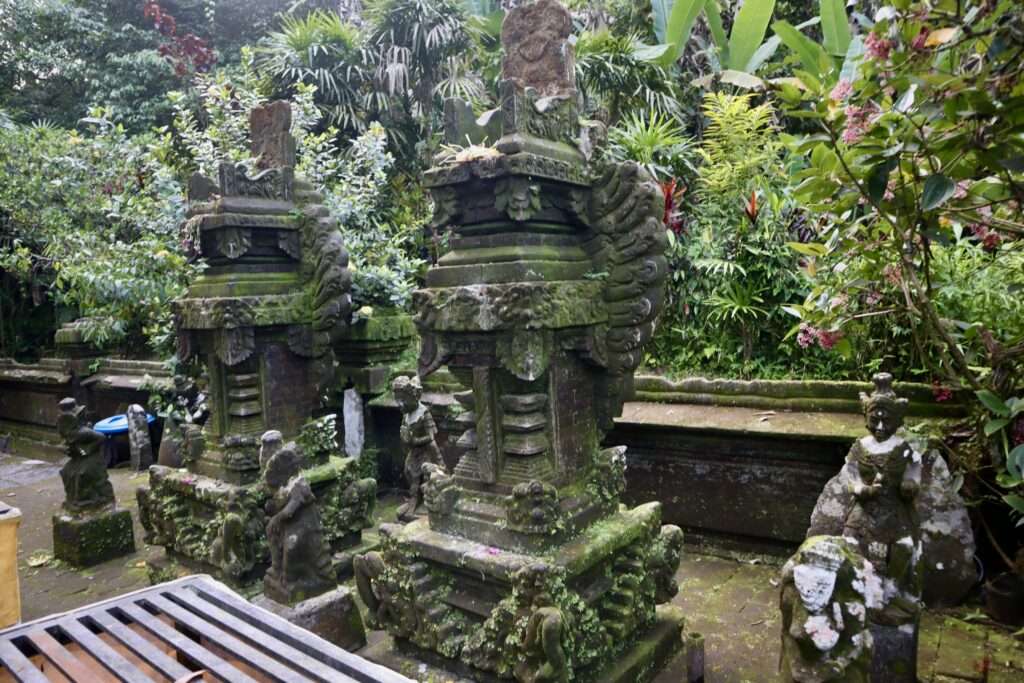
In the innermost courtyard stands Batukaru’s ancient main pelinggih (shrine), heavily covered in moss, part of the core sanctuary where Mahadewa and the forces of growth and water are worshipped, a very literal fusion of mountain, forest, and temple.
Pura Luhur Batukaru is esteemed as one of the revered Sad Kahyangan Jagat temples (the Six Temples of the Universe), the holiest temples in Bali, and is considered by some to be the oldest temple on the island. Legend has it that it was constructed in the 11th century by the revered sage Mpu Kuturan, who is credited with establishing a network of protective temples across Bali. He also played a pivotal role in uniting diverse faiths under the unique Balinese fusion of the Shiva-Buddha religion. This syncretic faith features a complex system of offerings and ceremonies designed to invoke and celebrate the divine.
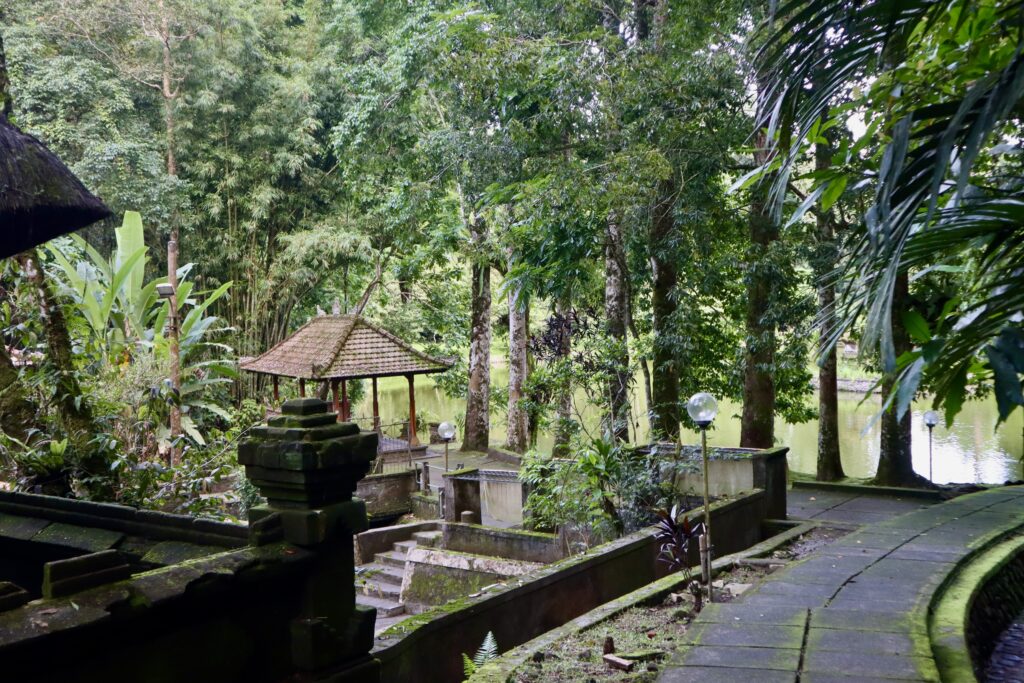
The expansive grounds of the temple consist of several distinct structures and a gorgeous lake, with fragments of an old shrine embedded in its middle, in an atmosphere of remarkable calm. Towering trees are scattered across the terrain, which is surrounded by dense mountain forest. The sloping temple grounds are a landscape marvel, with the upper plateau hosting the main temple, where stone paths lead through open courtyards, shrines shaded by thatched roofs, and moss-covered walls. Wide staircases connect the upper temple to the water temple at the lake, allowing visitors to move comfortably from one sacred enclosure to another. Balinese devotees always pray in each of the temples within the complex, each dedicated to different divine manifestations and guardians associated with the mountain and its surrounding realm.
Batukaru is also one of Bali’s nine directional temples (kayangan jagat), representing the west and dedicated to Mahadewa, guardian of Mount Batukaru and of the forests and waters that feed the rice fields. The temple sits high on the forested slope of the mountain, around 700 metres above sea level, surrounded by cool, wet air that encourages the thick moss and plants to grow directly on the shrines. Unlike most major temples, which are oriented toward Mount Agung, Batukaru faces its own mountain, highlighting its special link to the mountain deity. It is a major source of holy water for the subak irrigation cooperatives, so the shrines here are deeply intertwined with the life of the rice terraces and the fertility of the land.
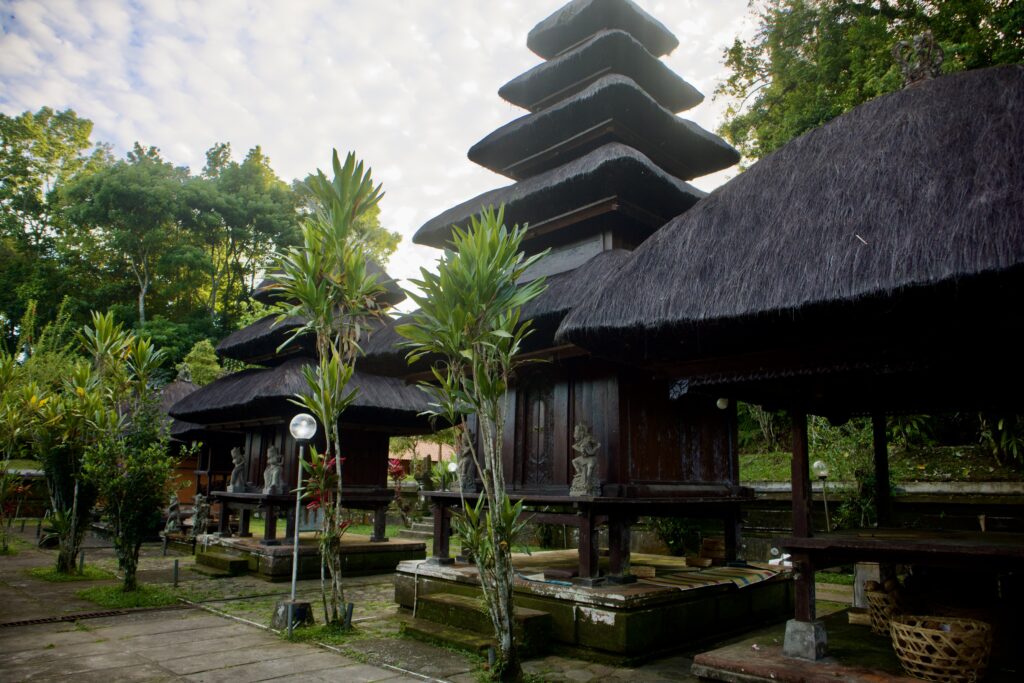
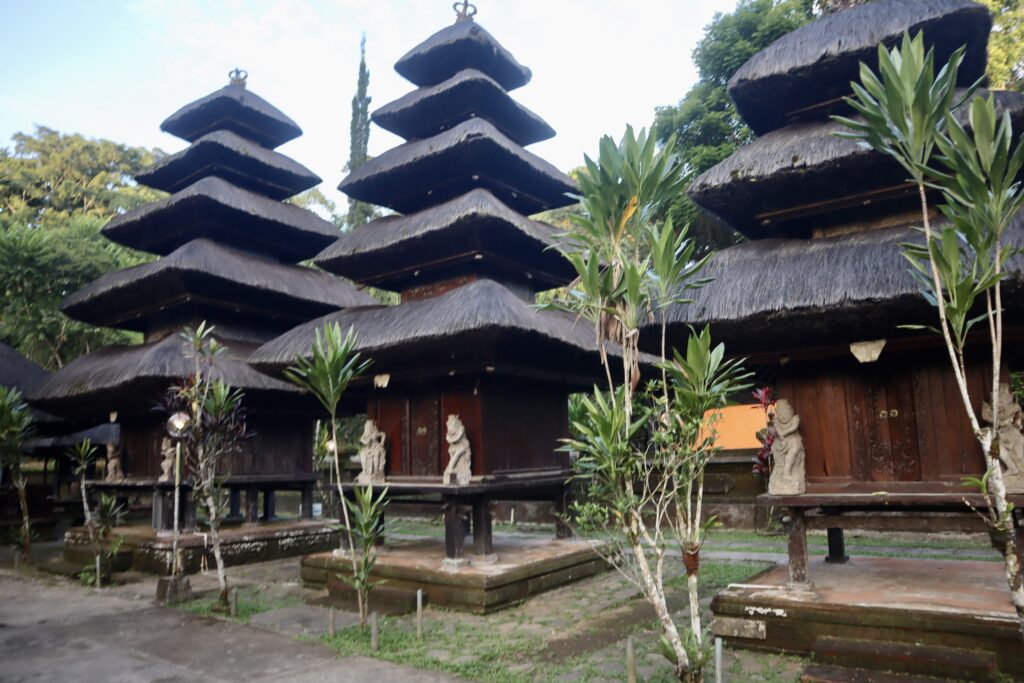
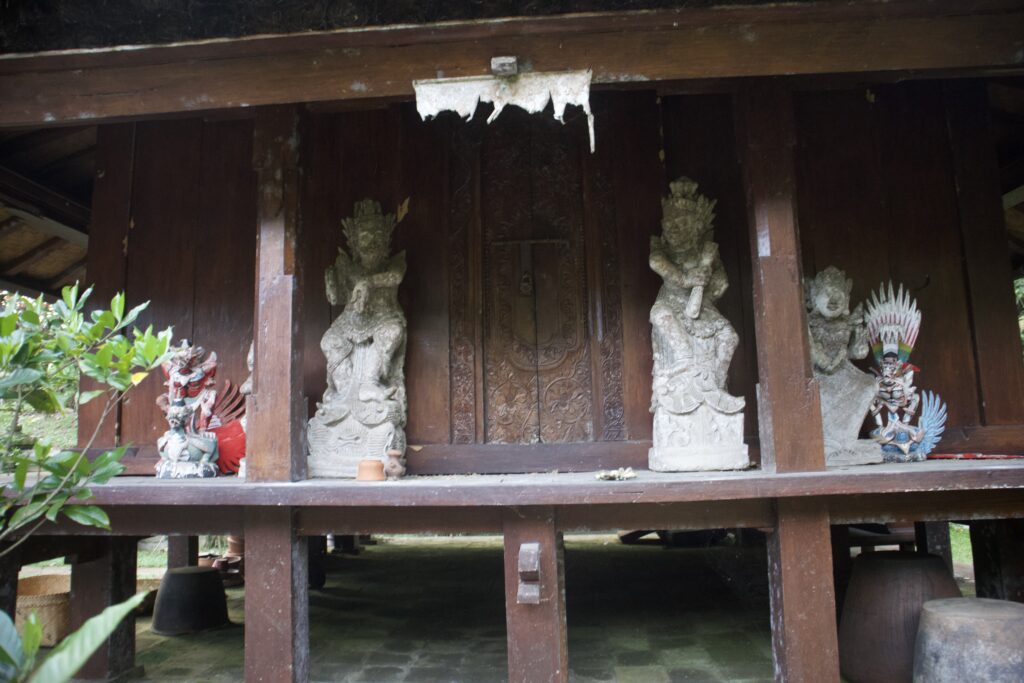
Row of dark thatched wooden shrines and pavilions, characteristic of Bali’s mountain temples.
The ancient origins and historical depth of Balinese temples are palpably present in their atmosphere, and notably across the entirety of Bali, the last bastion of the ancient Shiva-Buddha civilization. Much of this history is cloaked in mystery, making the exploration of the origins of Bali’s remarkable temple culture a daunting, if not impossible, task. Yet the allure and charm of Balinese temples captivate many.
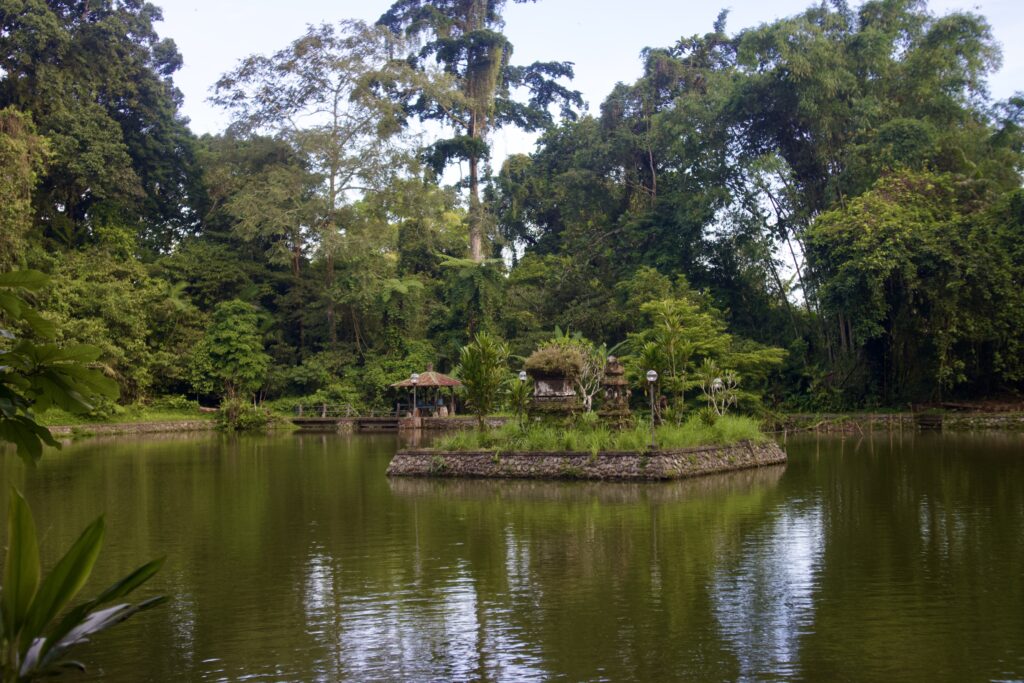
Serene lake within the grounds of Pura Luhur Batukaru, with an old shrine island embraced by deep green forest.
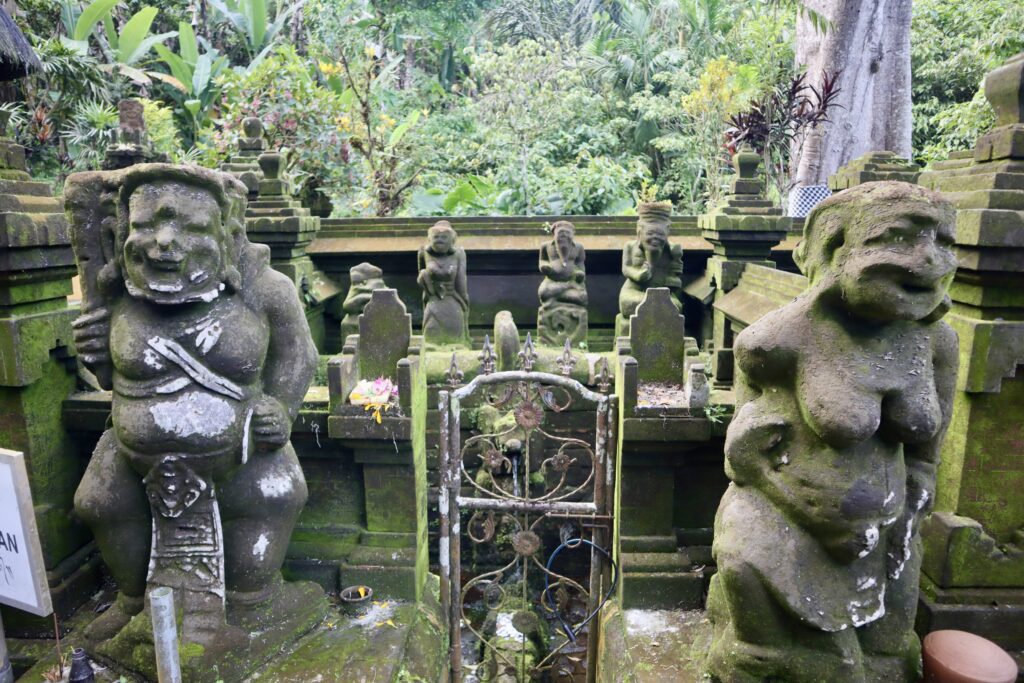
Ancient guardian figures at Pura Luhur Batukaru, their softened forms half absorbed into the moss covered temple walls, emerging like memories of an older Bali.
This is particularly true for Pura Luhur Batukaru, where the magical aura, ancient stone statues and shrines, along with other magnificent artifacts weathered by time, showcase breathtaking grandeur and evoke a profound sense of mystery. At the peak of worship and prayer, the indescribable beauty of the Balinese temple, a dwelling for the gods, uplifts the spirit and leaves an indelible mark on the soul.
-
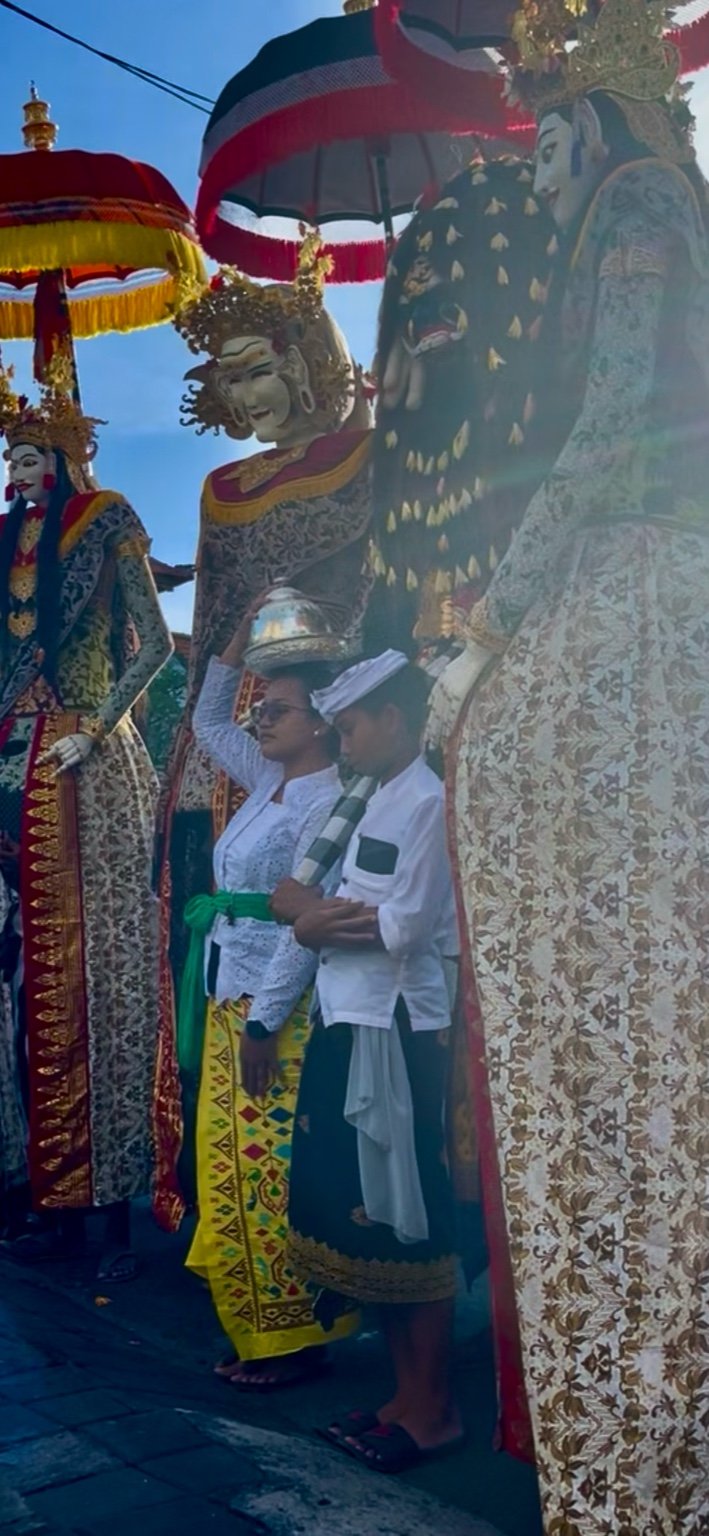
THE POWER OF SANUR AND THE ENCHANTING RITUALS OF TUMPEK WAYANG
This is a look back at the recent Tumpek Wayang ceremony in Sanur, a profound ancient ritual where the Barong Landung couple, Jero Gede and Jero Loeh, were reverently escorted through the streets. Sanur, with its magical temples, ongoing ceremonies, and as the home of High Priest families—the custodians of Balinese Hinduism—stands as the spiritual…
Leave a Reply